
Due Diligence Process
The due diligence process in project financing is the lender’s review of a project’s financial viability, repayment capacity, risks, legal position and security before deciding whether to provide financing. It allows lenders to assess project bankability, verify information supplied by the sponsor, identify material risks and determine whether the proposed financing structure meets their underwriting requirements.
For project sponsors, developers and asset owners, lender due diligence is where weaknesses in the business case, financial model, documentation, collateral or execution plan may become apparent. The scope varies depending on the financing structure, asset type, lender and transaction.
How Does the Lender Due Diligence Process Work?
1. Initial screening and financing assessment
The lender first considers whether the project fits its lending criteria, risk appetite and financing mandate. It reviews the project’s purpose, development stage, funding requirements, anticipated repayment sources and proposed capital stack.
This initial assessment may apply to project finance, private credit, secured lending, asset-based lending, real estate finance, acquisition or development finance, and infrastructure finance. The lender considers whether the proposed transaction is suitable for its financing mandate before committing resources to a detailed review.
2. Detailed due diligence and underwriting
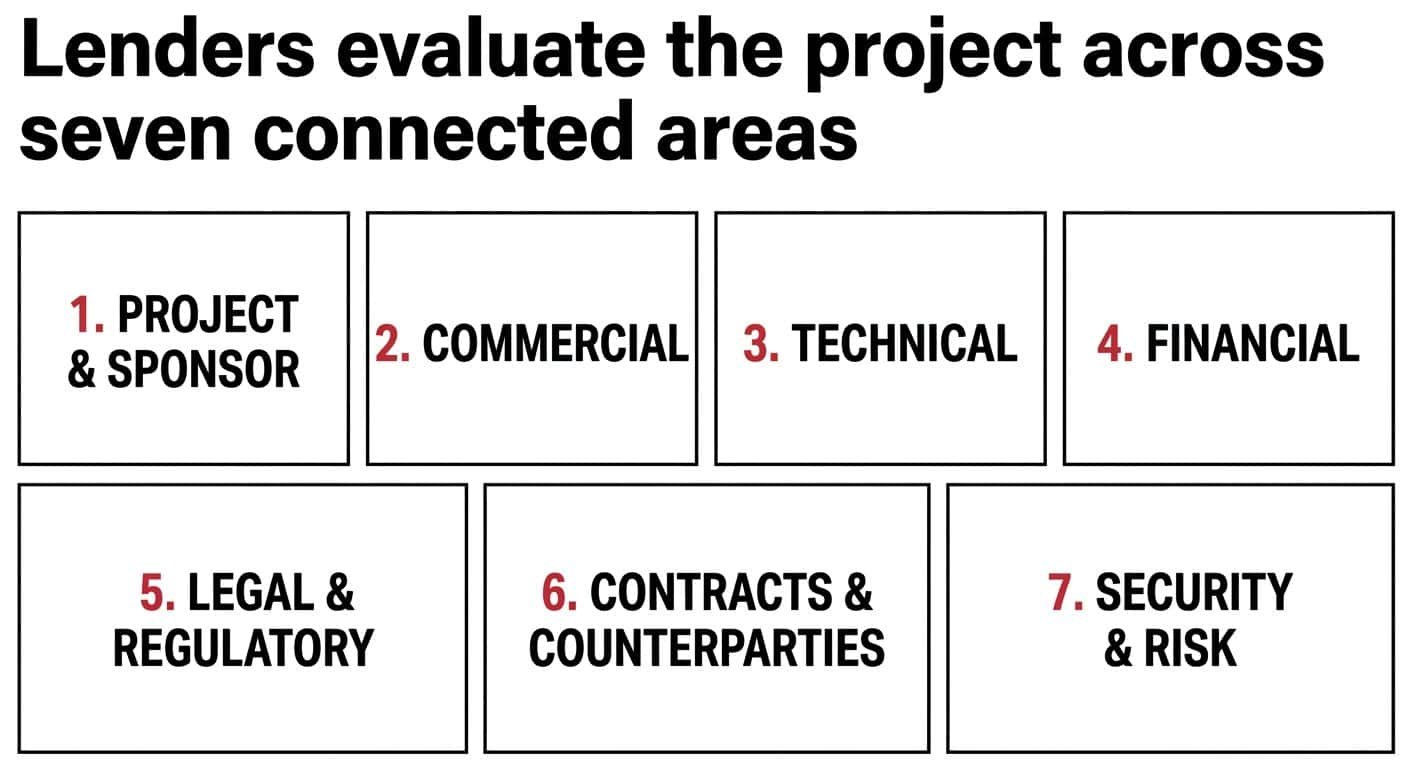
If the project progresses, the lender examines the information supporting the financing request. Depending on the transaction, this can include technical and commercial feasibility, market assumptions, financial projections, cash flow, repayment capacity, legal enforceability, permits, contracts, ownership and collateral.
The financial review focuses on whether projected cash flows can support debt service under the proposed financing structure, including less favourable scenarios where relevant. The legal and security review examines whether the lender can obtain and enforce the intended rights over assets, contractual cash flows or other collateral.
During underwriting, lenders compare the evidence against their requirements and investigate inconsistencies, missing information and risks that could affect repayment or recovery.
3. Risk assessment and identification of gaps
Lender review often exposes gaps that sponsors did not identify during project preparation. These may include unsupported revenue assumptions, incomplete permits, insufficient downside analysis, unclear repayment arrangements, weak contractual protections, inadequate collateral documentation or unresolved legal issues.
A gap does not automatically mean a project is unfinanceable. Its significance depends on the risk involved, whether it can be resolved, and whether the lender can accommodate it within the proposed financing structure. Some issues require additional evidence or changes to the transaction; others may prevent the lender from proceeding.
4. Financing structure and credit decision
Once the lender has assessed the evidence and principal risks, it determines whether the transaction can meet its credit requirements and on what terms. This may involve changes to the debt amount, tenor, repayment profile, collateral, covenants, guarantees or other protections.
The lender may issue indicative terms, seek further information, make any offer conditional on outstanding requirements, or decline the transaction. Any proposed financing remains subject to the lender’s approval process and applicable conditions.
How Can Sponsors Prepare Before Lender Due Diligence?
The key is to assess project bankability before submitting a financing request. A project may have a credible commercial case but still encounter difficulties if its financial assumptions, repayment capacity, legal position, security package or supporting documentation do not meet lender requirements.
Sponsors should understand not only whether the project is viable, but also whether the evidence supports the proposed financing structure and enables a lender to assess the risks. Identifying material gaps before formal review can help sponsors address weaknesses earlier, although it cannot guarantee financing approval.
For sponsors who want a structured way to assess these issues before approaching lenders, the AltFin Project Financing Scorecard provides a starting point for evaluating project financing readiness.
