
How to Write an Investment Memorandum That Answers Credit Questions
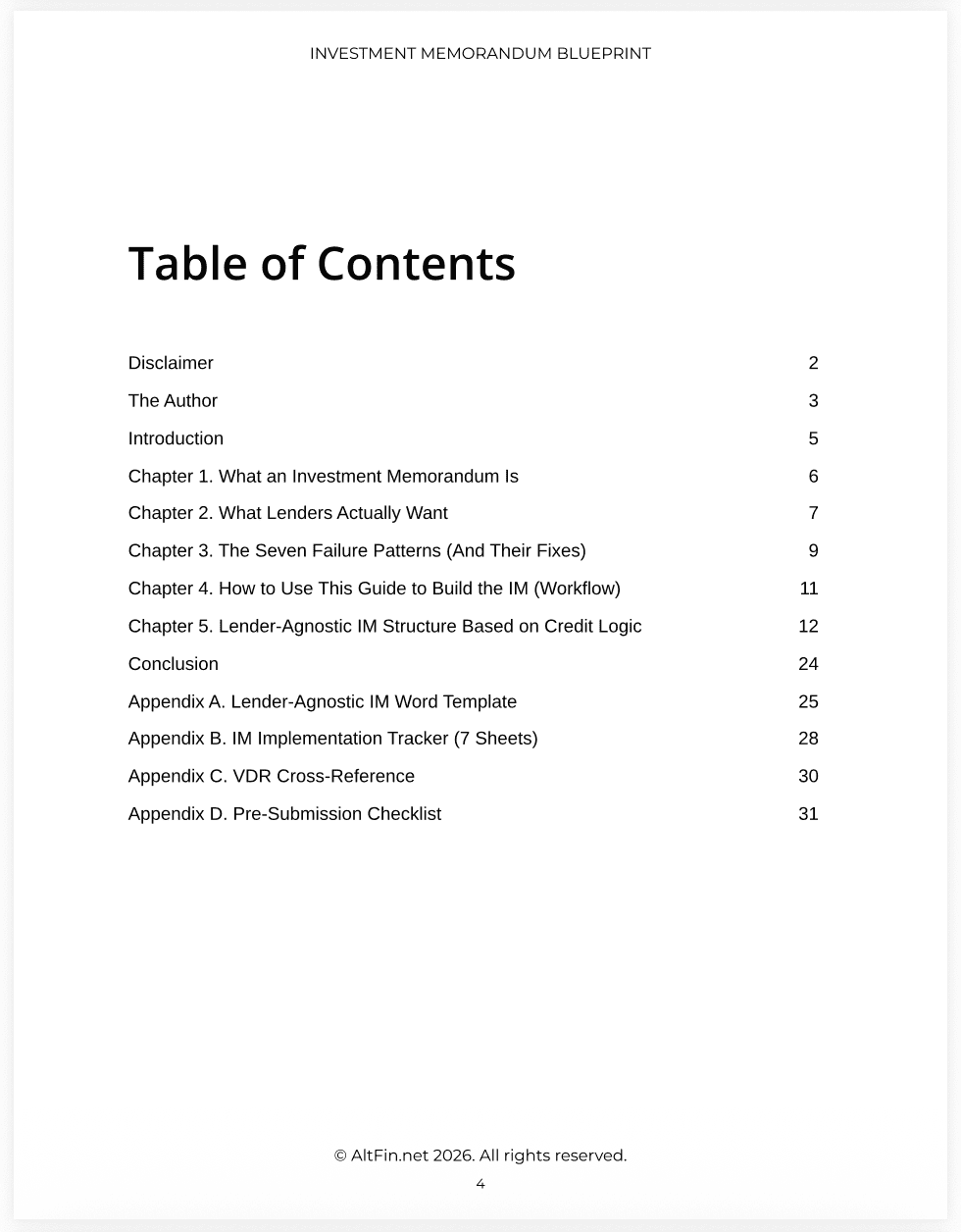
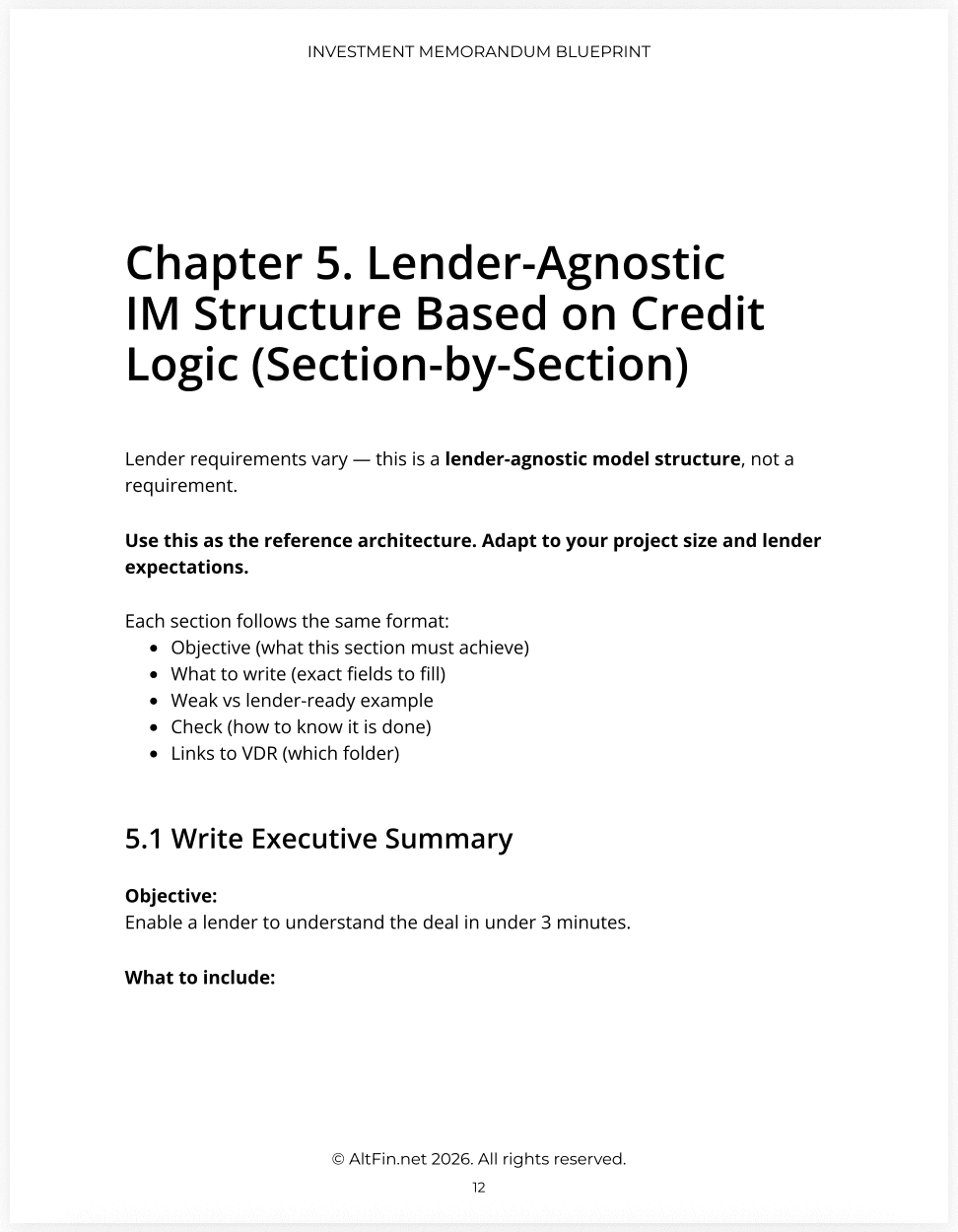
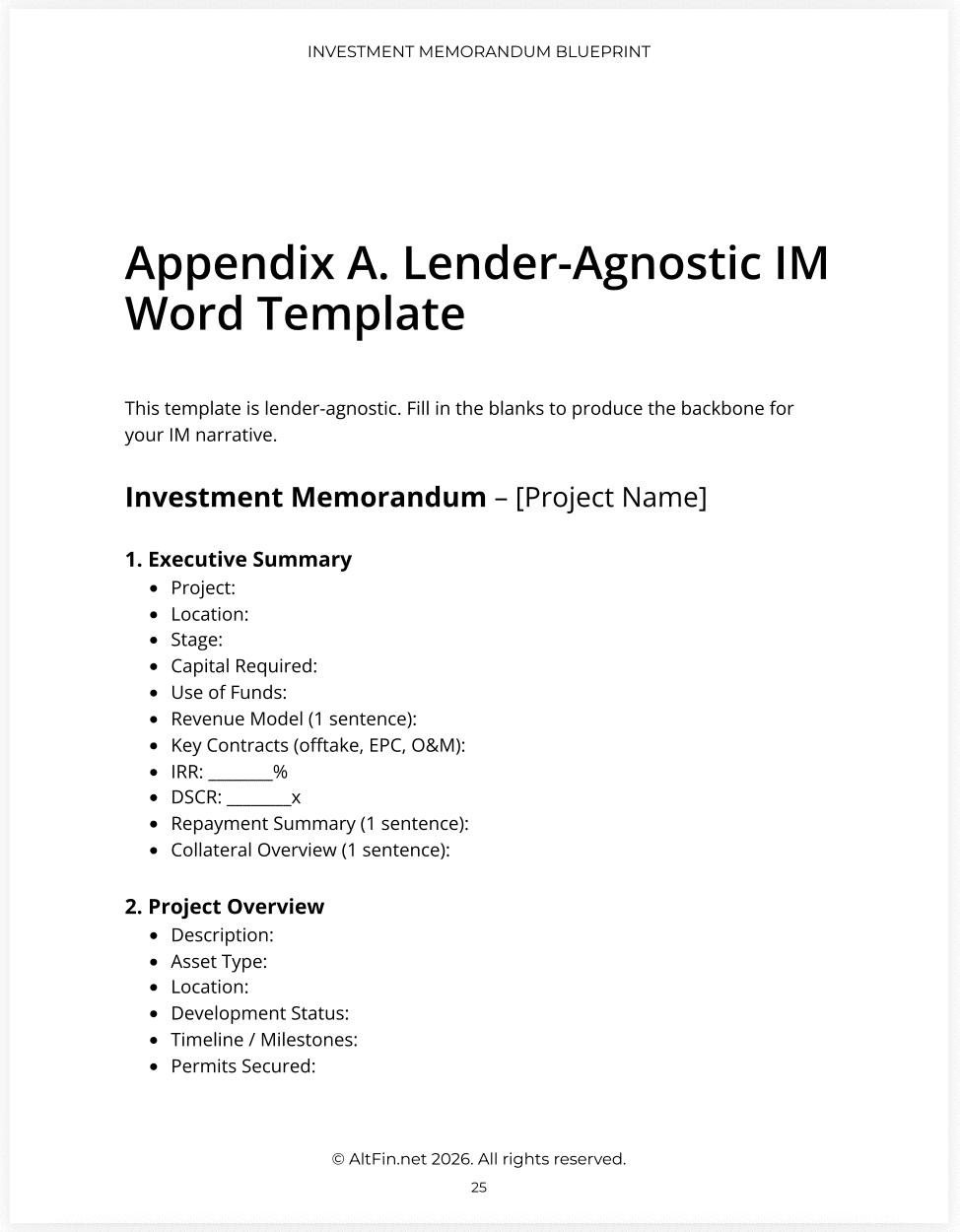
The AltFin Investment Memorandum Template is a practical guide that shows you how to structure your project’s IM for efficient lender review. It provides a standardized, lender-agnostic architecture designed to answer the five critical credit questions before they are asked, helping ensure your project is understood, not abandoned at first screen.
What You Get
The Complete IM Structure:
A section-by-section framework (from Executive Summary to Repayment Strategy) aligned with credit logic, including objectives, required content, and completion checks.
The Five Credit Questions Framework:
Learn to explicitly address Cash Flow, Structure, Risk, Repayment, and Security—the core criteria every lender review team evaluates.
Lender-Ready Examples:
See weak vs. lender-ready examples for each section to understand the standard of clarity required.
Four Ready-to-Use Tools:
Fill-in-the-Blank Investment Memorandum Template (Word) covering all core sections to build your narrative.
Implementation Tracker (Excel): 7-sheets for tracking inputs, revenue assumptions, capital structure, risks, collateral, and VDR alignment.
IM-VDR Cross-Reference to link to supporting documents correctly.
IM Pre-Submission Checklist to verify completeness and lender-readiness before submission.
How This Works
This blueprint mirrors the way credit teams actually review project finance documents. You’ll build your IM in a specific, logical sequence:
- Define the Deal: Craft an Executive Summary that allows a lender to understand the project in under three minutes.
- Answer the Five Core Questions: Systematically address Cash Flow, Structure, Risk, Repayment, and Security using the guide’s credit logic.
- Link Every Claim to Evidence: Use the VDR cross-reference framework to ensure every statement in your IM is supported by a verifiable document, eliminating credibility gaps.
- Run the Pre-Submission Checklist: Perform a final quality control review to catch and fix any structural weaknesses before the document reaches a lender.
Following this logic ensures a clean, reviewable IM is the first thing a lender sees.
What This Guide Helps You Avoid
Endless clarification requests
Missing or unclear repayment strategy
Unsupported assumptions
Poorly structured risk presentation
Disconnected sections
Claims unsupported by evidence
Avoidable diligence delays
Endless revision cycles
Sending an incomplete memorandum to lenders
Discovering structural weaknesses too late
Who This Is For
This guide is designed for developers and sponsors preparing projects seeking $10M–$100M+ in financing. It is particularly relevant for sectors including:
- Infrastructure
- Renewable Energy
- Real Estate & Hospitality
- Oil & Gas
It is intended for sponsors who want to reduce avoidable lender questions, diligence friction, and structural weaknesses before lender review begins.
Why This Matters
This methodology is built on AltFin’s experience screening over $1.45 trillion in global project deal flow. The structure applies the same discipline used by credit teams to help you present your project in a way that aligns with how credit decisions are actually made.
Lenders do not reward vision; they reward clarity, structure, and risk control. This guide helps you deliver exactly that.
Frequently Asked Questions
Does the Blueprint include an Investment Memorandum Template?
Yes. The Investment Memorandum Blueprint includes a Word Investment Memorandum Template that provides the structure and framework for developing an investment memorandum for a project seeking institutional financing.
It also explains the format, structure, and content required for each section, so the template is not simply a blank document. The Blueprint shows you how to develop an investment memorandum that presents the project, financing structure, financial case, risks, security, and supporting evidence in a form suitable for institutional review.
If you are looking for an investment memorandum example, investment memorandum sample, or investment memorandum format, the Blueprint provides the underlying structure and working template you can adapt to your own project.
Every lender has different requirements. Will this still help?
Yes. While lender-specific requirements vary, credit teams evaluate the same core issues: cash flow, repayment, risk, security, and structure. This guide focuses on those universal principles.
We already have advisors. Is this still useful?
Yes. It helps improve sponsor-side preparedness before external review, reducing avoidable gaps, confusion, and revision cycles. This guide helps you establish the correct internal discipline at a fraction of the cost.
Can this replace legal or financial advice?
No. This is a preparation and structuring framework, not legal, financial, or investment advice.
What if our project is still early-stage?
The framework helps identify what lender reviewers expect before outreach begins, allowing you to address gaps earlier in the process.
Will this guarantee funding?
No. No guide can guarantee financing. This blueprint is designed to materially improve the likelihood of your project receiving a serious review by preventing common, preventable structural errors and presentation gaps.
Write an Investment Memorandum That Answers Credit Questions Before Lenders Ask Them
One-Time Investment: $97
Get Instant Access