
Why Lenders Go Silent — And How to Fix It
The Problem Isn’t Capital
That’s What the Capital Readiness System (CRS) is Built to Help You Find and Fix.
You’ve spoken with lenders. You’ve submitted materials. You’ve received initial interest.
Then things slow down. More documents are requested. Questions multiply. Timelines stretch. Responses become less frequent. Progress stalls — and nobody clearly explains why.
Projects are frequently filtered before meaningful review begins because lenders identify structural weaknesses, documentation gaps, repayment concerns, collateral deficiencies, or execution risks that have not yet been addressed.
Lender review is not a process of discovering why a project should be funded. It is a process of identifying reasons why it should not — and underwriting begins long before the term sheet.
The challenge is that sponsors rarely receive a detailed explanation. They simply experience silence.
At that point, most sponsors assume they need better introductions, better financing contacts, or another advisor.
That’s an expensive problem. Every month spent chasing lenders without without addressing the underlying financing and lender requirements is a month of delayed funding — and a month of burned credibility.
CRS was built to help you uncover those issues – whether before you approach lenders, or after you’ve experienced unexplained silence and need to understand what went wrong.
Getting a Project Financed Is Not About More Documents
Many sponsors assume readiness simply means having enough documents.
Getting a project through lender review is not about document volume. It is document structure, evidence quality, consistency, traceability, and lender usability.
A project may have thousands of pages of documentation and still appear not prepared for the lender.
Why? Because reviewers must be able to answer five questions quickly:
- What exactly is being financed?
- How does repayment occur?
- What risks exist?
- How are those risks mitigated?
- What evidence supports the conclusions?
When those answers are difficult to locate, confidence falls, deals slow down, and momentum disappears.
CRS helps sponsors organise project information around the questions reviewers actually ask.
Start With a Capital Readiness Assessment
Capital Readiness System (CRS)
The Complete System to Diagnose, Structure, and Build a Lender-Ready Submission Package.
CRS is a structured, 9-module, lender-agnostic project preparation system. It combines a structured self-assessment — a simplified credit-screening model — with an execution system that guides project owners and sponsors through the preparation required for underwriting, credit review, and due diligence. Built around actual credit workflow logic, CRS helps sponsors assess their project from a lender’s perspective, identify gaps, and systematically prepare the materials, structure, and supporting evidence required for financing requirements, financing structures and lender review.
What You Get:
The system is divided into two integrated parts: a Diagnostic System (Modules 1-3) to identify issues and an Execution System (Modules 4-9) to fix them and build your submission. You receive immediate access to:
Diagnostic System (Identify Existing Issues)
1. System Overview & Workflow
Understand the methodology, scoring logic, and how to use the system.
2. Due Diligence Document Registry
Identify missing, incomplete, or weak project documentation.
3. Credit Signals Assessment (Bankability)
Evaluate project financeability across financing structure, execution, legal enforceability, collateral and repayment.
Execution System (Build Your Submission)
4. Capital Stack Configuration Guide
Build a clear capital stack and financing structure with a Sources & Uses Table and Repayment Structure.
5. Collateral Structure Guide
Structure and document collateral with a Collateral Register and Coverage Table.
6. Virtual Data Room (VDR) Blueprint
Organize your VDR using a lender-agnostic structure checklist and naming conventions.
7. Feasibility Study Guide
Structure a credible, 5-section study (Market, Technical, Financial, etc.) with clear pass/fail criteria.
8. Investment Memorandum (IM) Blueprint
Write a credit-oriented IM using a structured, lender-agnostic Word template.
9. Lender Submission Protocol
Package all outputs into a single, cohesive submission for lender, investment committee, or DD review.
How It Works:
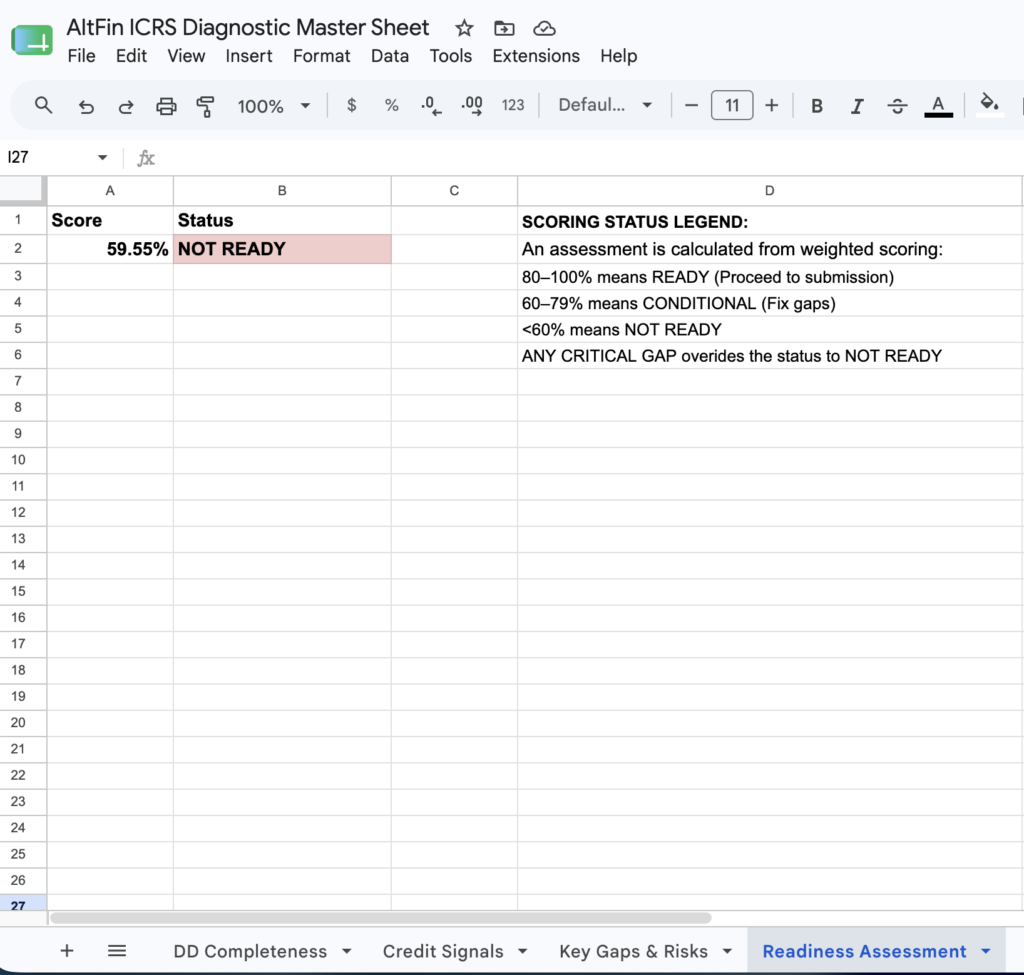
- Diagnose: Complete Modules 1-3 to assess your project against lender, financing and due-diligence requirements. The Project Financing Scorecard produces a clear Readiness Assessment (Ready, Conditional, or Not Ready) and identifies Critical Gaps, High Priority Gaps, and Structural Weaknesses.
- Execute: Use Modules 4-9 to address the identified gaps. Each module guides you through building a specific component of your submission package (e.g., IM, VDR, Feasibility Study).
- Package: Module 9 provides the final protocol to compile all your completed work into a structured, submission-ready package that lenders can evaluate efficiently.
What You Receive
THE DIAGNOSTIC SYSTEM (Modules 1–3)
MODULE 1
System Overview & Workflow
Understand how the Capital Readiness System works and how to use it correctly.
This module explains the workflow, assessment methodology, scoring logic, and how how lenders evaluate financing structures, due diligence documentation and project risk.
This module answers one question:
Am I ready for lender due diligence, and where do I start?
Included:
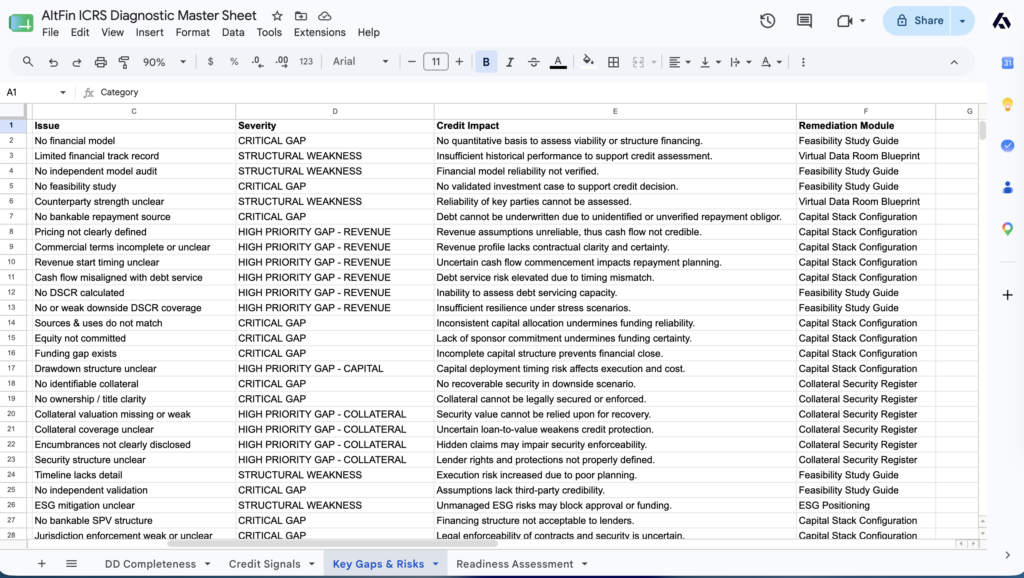
AltFin Project Financing Scorecard
The Project Financing Scorecard produces:
Readiness Assessment identifying:
Ready
Conditional
Not Ready
Key Gaps & Risks identifying:
Critical Gaps
High Priority Gaps
Structural Weaknesses
The potential credit impact of each identified issue
The recommended remediation module for each gap
Module 2
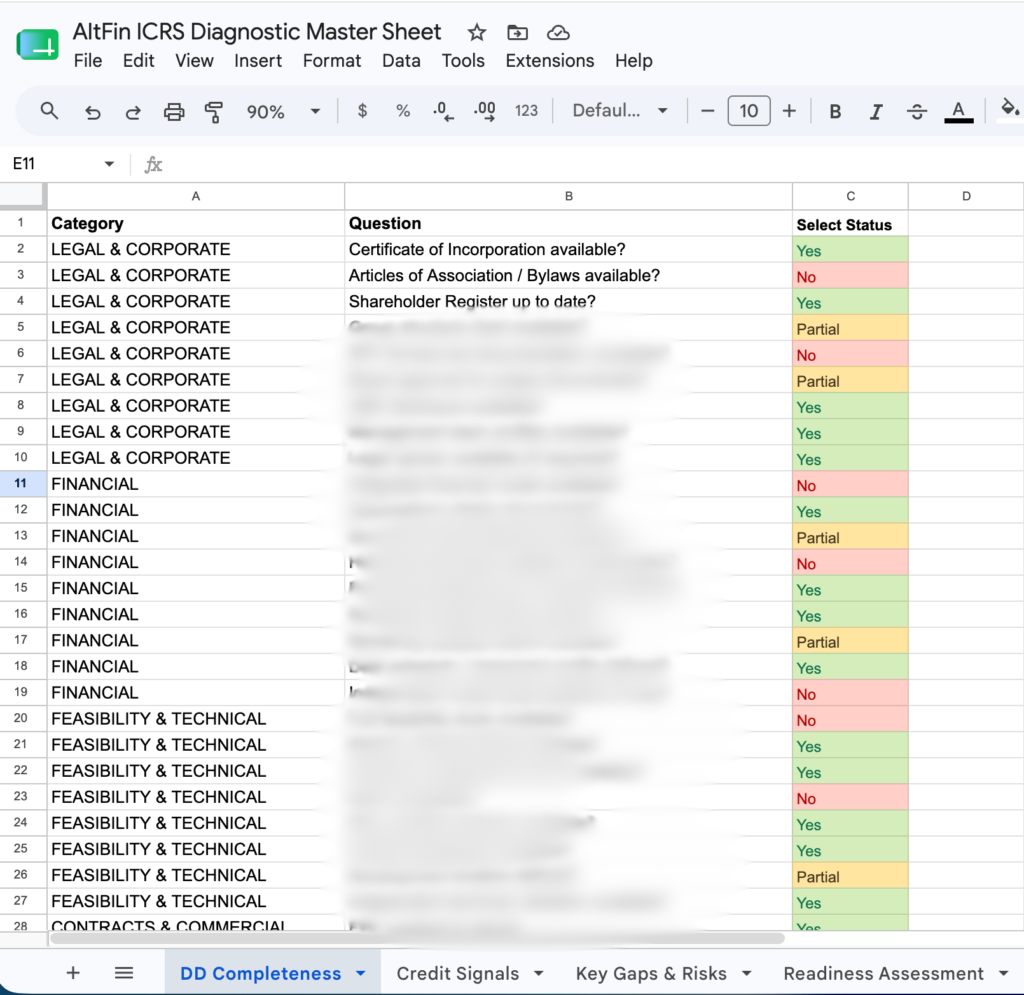
Due Diligence Document Registry
A lender-agnostic document registry designed to identify missing, incomplete, weak, outdated, or non-actionable project materials.
This module answers one question:
What documents do I need?
The outputs feed directly into the readiness assessment and gap analysis process.
MODULE 3
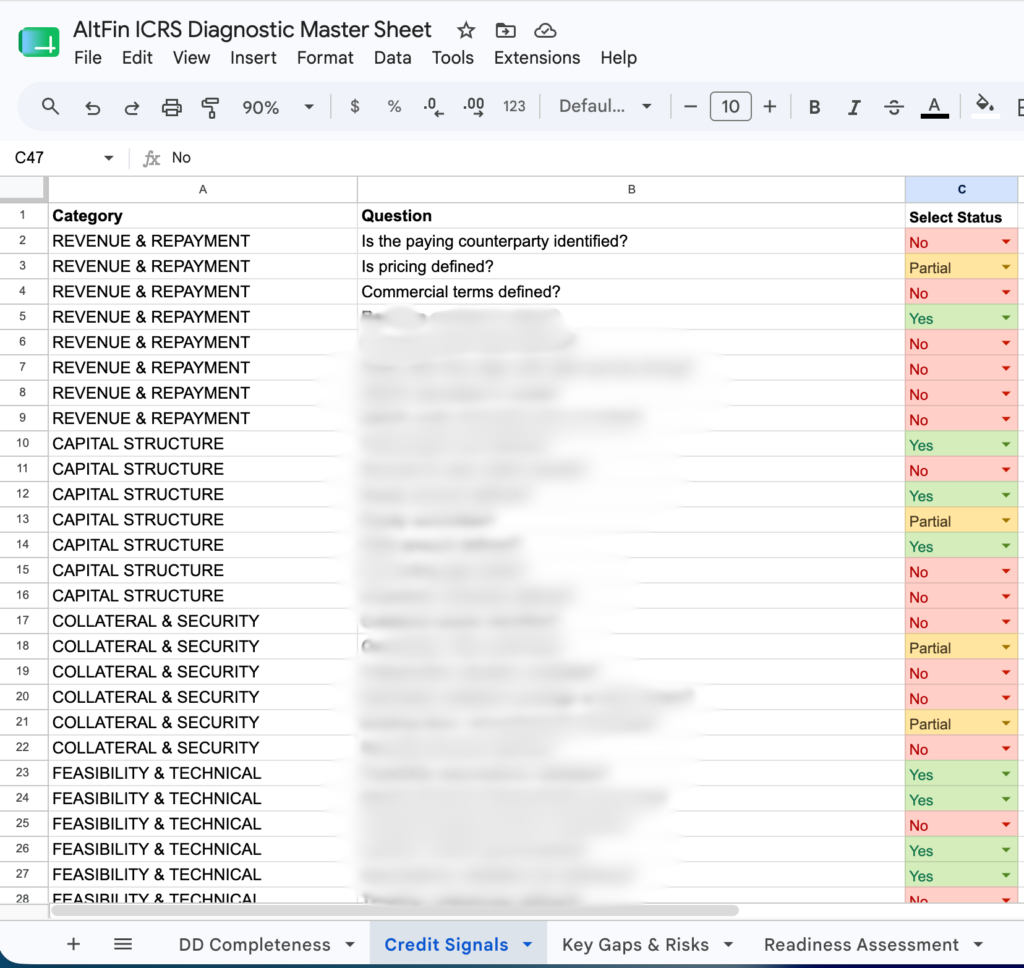
Credit Signals Assessment (Bankability)
Evaluate whether your project structure appears financeable based on the available evidence.
This module answers one question:
Is my project bankable?
The assessment covers: repayment credibility, revenue reliability, capital structure logic, collateral strength, execution readiness, legal enforceability, technical credibility, sponsor capability, and bankability.
THE EXECUTION SYSTEM (Modules 4–9)
Module 4
Capital Stack Configuration Guide
Build a capital stack that lenders can use for credit review.
This module answers one question:
What exactly am I asking for?
After completion, you will have: total project capital requirement, Sources vs Uses reconciliation, funding gap identified or documented, repayment structure (primary + fallback), capital layers (debt, equity, mezzanine), and a Capital Stack Summary.
Included:
Downloadable Template Pack:
Sources & Uses Table
Capital Stack Summary
Repayment Structure Template
Capital Layers Table
Drawdown Schedule Template
Debt Service Review Checklist
Capital Stack Pre-Submission Checklist
MODULE 5
Collateral Structure Guide
Assess, structure, and document collateral in a format lenders can evaluate for secured lending.
This module answers one question:
What security am I offering, and will the lender actually accept it?
After completion, you will have: collateral types identified, security positions defined, an enforceability assessment, documentation gaps identified or documented and a Collateral Position Summary.
Included:
Downloadable Template Pack:
Collateral Register Template
Lender Coverage & Priority Table
Collateral Pre-Submission Checklist
Module 6
Virtual Data Room Blueprint
Build a Virtual Data Room that reviewers can navigate quickly and efficiently.
This module answers one question:
How do I organise my VDR?
After completion, you will have: a complete VDR folder structure aligned with lender sequencing logic, including file naming conventions, and a pre-submission validation process.
Included:
Downloadable Template Pack:
Lender-Agnostic VDR Structure Checklist
Access, Permissions & Platform Control Checklist
VDR Pre-Submission Checklist
MODULE 7
Feasibility Study Guide
Structure a feasibility study that lenders can rely on during underwriting and due diligence.
This module answers one question:
What do I need to prove?
After completion, you will have: a five-section feasibility study (Market, Technical, Financial, Legal, ESG) with clear pass/fail criteria for each section, plus a pre-submission checklist.
Included:
Downloadable Template Pack:
Feasibility Study Section-by-Section Input Checklist
Expert Deliverables Tracking Sheet
Feasibility Study Executive Summary Template
Feasibility Study Pre-Submission Checklist
Module 8
Investment Memorandum Blueprint
Develop an Investment Memorandum aligned with credit workflow logic.
This module answers one question:
How do I write an Investment Memorandum?
After completion, you will have a complete IM structured around credit workflow logic, with clear pass/fail criteria for each section, plus a pre-submission checklist.
Included:
Downloadable Template Pack:
Lender-Agnostic IM Word Template
IM Implementation Tracker (7 sheets)
IM-VDR Cross-Reference Framework
IM Pre-Submission Checklist
MODULE 9
Lender Submission Protocol
Convert all completed outputs into a structured financing application and submission package suitable for lender, investment committee, and due diligence review.
This module answers one question:
How do I package everything for lenders?
The system is designed to help you produce:
- Executive Submission Brief
- Investment Memorandum
- Feasibility Study
- Capital Stack Summary
- Collateral Position Summary
- Structured Virtual Data Room
- Submission-ready package suitable for lender review
Included:
Downloadable Template Pack:
Executive Lender Submission Brief Template
Lender Package Assembly Sheet
Consistency Review Template
Lender Pre-Submission Checklist
Who This Is For
Project Sponsors pursuing debt from financing institutions, including private credit, project finance, structured finance, asset-based lending, acquisition finance and development finance for:
- Infrastructure, Renewable Energy, and Energy Transition projects.
- Real asset developments and Project Finance transactions.
Specifically Valuable If:
- You are preparing a loan application or to approach lenders.
- You have engaged lenders, but progress has stalled due to vague feedback or endless DD requests.
- You want to identify weaknesses and improve submission quality agaisnt financing requirements before or during lender review.
This System Is Not For:
- Startup fundraising, Venture Capital, Angel investment, or crowdfunding.
- Early-stage concepts without a defined project.
- Replacing legal, financial, or specialist advisory where required.
Investment
Capital Readiness System (CRS)
$4,950 One-Time Payment
Immediate Access Includes:
All 9 CRS Modules, including:
Project Financing Scorecard
Due Diligence Document Registry
Credit Signals (Bankability Assessment)
Capital Stack Configuration Guide
Collateral Structure Guide
Virtual Data Room Blueprint
Feasibility Study Guide
Investment Memorandum Blueprint
Lender Submission Protocol
26 Practical Tools, including Assessment Tools, Frameworks, Templates, and Checklists
Lifetime Access to this version of the system.
Why Sponsors Prepare Before Lender Engagement
Most projects don’t fail because the opportunity is weak. They fail because weaknesses stay hidden until lender review begins — by which point momentum, credibility, and timelines are already damaged.
CRS helps you discover critical gaps and weaknesses before lenders do. Identify issues before they create friction. And present your project in a format lenders can efficiently evaluate.
One-Time Investment: $4,950
Frequently Asked Questions
How do I know if my project is actually ready?
That’s the exact question the CRS Diagnostic is designed to answer. It will produce a readiness assessment and a prioritized remediation roadmap.
Will this apply to my project?
CRS is built around lender review logic, not sector-specific fundraising advice. It is designed for mid-market capital projects seeking debt or structured finance across sectors such as infrastructure, energy, renewables, logistics, industrial projects and real assets.
My project is unique. Can a standardized system really account for its complexity?
Yes. CRS is designed around the lender review issues that remain relevant regardless of a project’s sector, jurisdiction, structure, or specific assets. Your project may be unique, but lenders still need to assess core areas such as repayment, collateral, documentation, execution, legal enforceability, and risk. CRS provides the structure for assessing and documenting those areas without assuming every project is identical.
If I still have to do the work, why should I buy a system instead of hiring an advisor?
CRS is designed to reduce the work that comes from uncertainty, fragmented preparation, repeated document requests, and rework. Instead of paying an advisor to manage the financing preparation process, you use a structured system to diagnose gaps, organize the required work, and build the submission yourself — with specialist advisors engaged where their expertise is actually required.
We already have a lot of documents. Do we still need this?
Having documents is not the same as meeting lender requirements. CRS helps determine whether your documentation is complete, consistent, and structured in a way lenders can use efficiently.
Our project is still early-stage. Should we wait?
No. The earlier you identify structural weaknesses, the easier and less expensive they are to address. CRS is designed to help you assess the project against financing and lender requirements before lender exposure.
We’ve already spoken with lenders. Is it too late?
No. Many sponsors use CRS after experiencing delays, repeated due diligence requests or reduced lender engagement. It helps identify the structural issues that may be slowing the process.
Is this another educational course?
No. CRS is an execution system. Its purpose is to help you produce a lender-ready submission package — not teach project finance theory.
How long does it take to complete CRS?
The Diagnostics (Modules 1-3) can be completed in a few hours if your information is available. The Execution Modules (4-9) timeline depends on your project’s complexity and the gaps identified.
Can this replace external advisors?
Not entirely — and it isn’t designed to. CRS is designed to help sponsors reach a lender submission standard before external advisory escalation, enabling them to identify and address financing, documentation and lender-review gaps before deciding where specialist advice is genuinely required.
Do lenders want to work with a developer using a system rather than an advisor?
Lenders care about the quality, consistency, traceability, and usability of the information they receive — not whether a third-party advisor assembled it. CRS helps sponsors structure their project information around lender review logic so the submission can be evaluated efficiently. It does not replace specialist advisors where their expertise is required.
We don’t have a large team. Do we need dedicated staff to use CRS?
No. CRS is designed to be used by project sponsors and their existing project team. It provides the structure, workflows, templates, and checklists needed to organise the preparation process without requiring a large internal team. Specialist advisors can still be engaged where specific expertise is required.
How do I know the assessment logic and templates are reliable?
CRS is built around generalized project finance and underwriting principles and is designed to reflect the questions and evidence requirements that arise during lender review. The system provides structured assessment logic, defined criteria, templates, and validation checklists to help reduce inconsistency and omissions. It does not guarantee lender acceptance or financing approval.
Will this help secure funding?
No system can guarantee funding. CRS is a preparation system designed to improve your financing preparation and help you produce a submission package that meets lender review requirements. This reduces friction and increases clarity.
Before You Spend Another Month Pursuing Financing…
Ask yourself a simple question.
If lenders reviewed your project today — would you know what they would find? Where the weaknesses are? What concerns they would raise? Whether the project is actually ready?
Most sponsors cannot answer those questions with confidence.
And that’s exactly why projects stall. Not because the opportunity lacks potential. Because uncertainty remains unresolved.
CRS removes that uncertainty. It helps you identify what lenders will see. Strengthen what is weak. Organise what is scattered. And build a lender-ready submission package before lender review begins.
What you don’t know about your project’s financing and lender-review position is actively costing you time, credibility, and access to capital.
