
Due Diligence Questionnaire
A due diligence questionnaire is used by lenders and financing providers to collect the information needed to assess a borrower, project, transaction, and proposed financing structure. In project and structured financing, the questions are designed to uncover whether the underlying business or asset is commercially viable, projected cash flows support repayment, the proposed security package is adequate, and whether material legal, technical, commercial, or financial risks could affect the financing.
For a project sponsor or borrower, the questionnaire is therefore more than a request for documents. It is an early indication of the issues an underwriter will examine before determining whether a financing opportunity merits further review.
What does a lender due diligence questionnaire ask?
The exact questions vary by financing type, lender, transaction structure, and risk profile. A project-finance questionnaire will generally address several core areas.
Project and transaction
Typical questions establish what is being financed, who owns and controls the project, and how the transaction is structured.
Representative questions include:
- What is the purpose and scope of the project?
- Who are the project sponsors, owners, and key counterparties?
- What stage has the project reached?
- What financing is being requested, and for what uses?
- What is the proposed capital stack?
- What financing structures are being considered?
These questions help the lender understand the transaction before assessing its individual risks.
Commercial and market position
Lenders need to understand how the project will generate revenue and whether its commercial assumptions are credible.
Questions may include:
- What is the source of project revenue?
- Who are the customers, purchasers, or offtakers?
- Are material contracts already in place?
- What supports the projected pricing and demand?
- What market or competitive assumptions underpin the financial model?
The objective is to determine whether projected revenue is sufficiently supported to form a credible basis for underwriting.
Financial performance and repayment capacity
Financial questions focus on the project’s ability to meet its obligations under the proposed financing.
A lender may ask:
- What are the historical and projected revenues and operating costs?
- What are the principal assumptions in the financial model?
- What is the expected debt service?
- What supports the projected repayment capacity?
- What coverage ratios are expected under the base case and downside cases?
- What existing debt or financial obligations must be considered?
These questions are central to a bankability assessment, because a financing structure ultimately needs sufficient cash-flow support for its obligations.
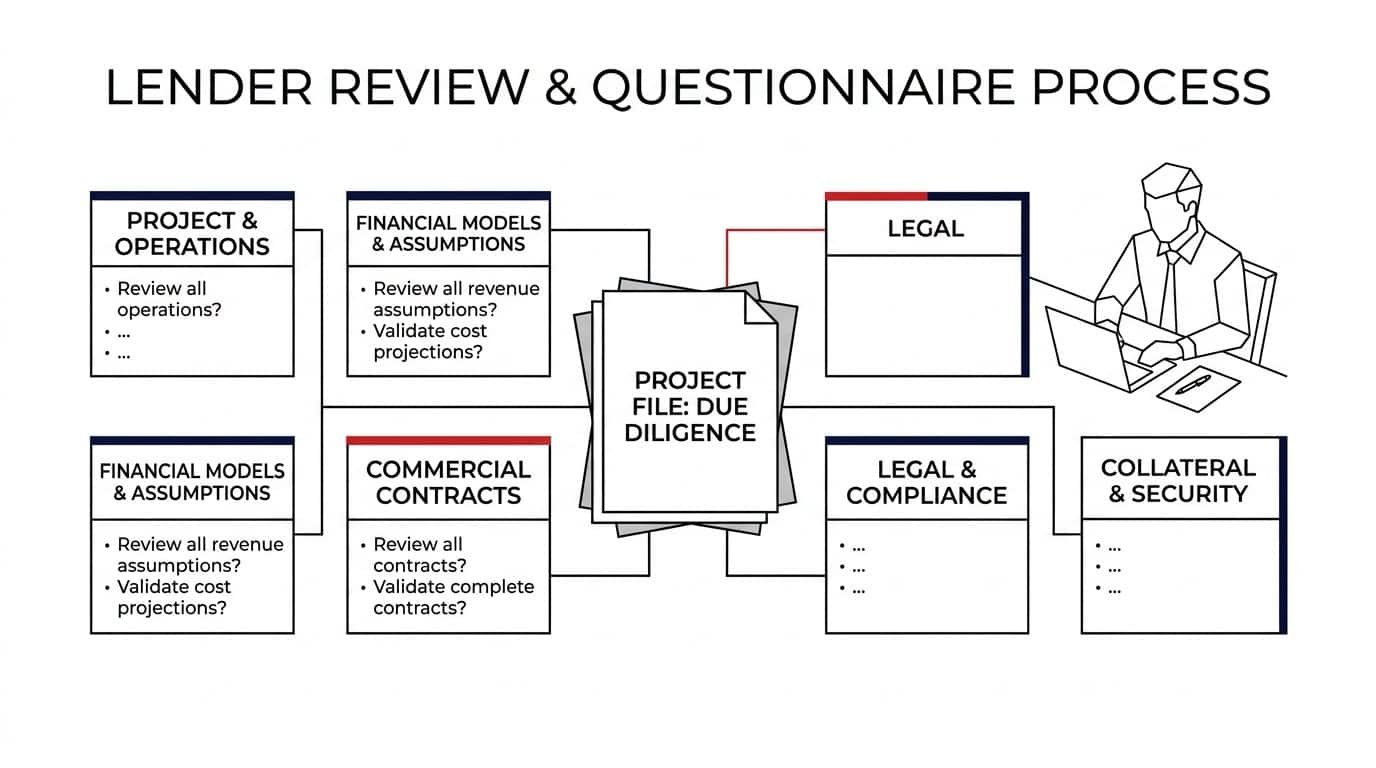
Assets, collateral, and security
Where financing is secured, lenders will examine the assets and contractual rights available to support the transaction.
Questions may address:
- What assets are available as collateral?
- Who owns those assets?
- Are there existing liens or security interests?
- What contractual or other rights can be assigned or pledged?
- What security package is contemplated?
- Are there restrictions affecting the lender’s ability to enforce its security?
The specific requirements differ between project finance, secured lending, asset-based lending, real estate finance, acquisition or development finance, and private credit transactions.
Legal, regulatory, and project risks
The questionnaire will also identify matters that could prevent the project or transaction from operating as assumed.
Representative questions may cover:
- Are required permits and approvals in place?
- Are there material litigation or regulatory issues?
- Are key contracts legally enforceable?
- Are there material obligations or liabilities that could affect the transaction?
- Are there insurance arrangements appropriate to the project and its risks?
These questions help the lender identify risks that could affect cash flow, collateral, enforceability, or repayment.
What is a due diligence questionnaire designed to uncover?
At its core, lender due diligence is intended to determine whether the information supporting the financing request is sufficiently credible, complete, and consistent for underwriting.
A questionnaire can help expose:
- unsupported financial or commercial assumptions;
- weaknesses in repayment capacity;
- gaps between the proposed financing and the capital stack;
- insufficient or encumbered collateral;
- material contractual or regulatory risks;
- inconsistencies between project documents and financial projections;
- financing requirements that have not been fully addressed.
The same principles can apply beyond traditional project finance. Depending on the transaction, similar due-diligence questions may arise in structured finance, private credit, secured lending, asset-based lending, real estate finance, infrastructure finance, and acquisition or development finance.
Due diligence questionnaire vs. lender requirements
A due diligence questionnaire should not be confused with a definitive list of lender requirements. The questionnaire is part of the information-gathering and underwriting process; the lender’s requirements will depend on the specific transaction, risk profile, financing structure, jurisdiction, and credit policy.
For that reason, completing a questionnaire does not mean that a transaction meets a lender’s credit requirements or will receive financing.
Preparing for lender due diligence
For sponsors and borrowers, the practical question is whether the information available for the financing request can withstand lender review.
A structured bankability assessment can help identify weaknesses before they become issues during underwriting, particularly around repayment capacity, coverage ratios, collateral, financing requirements, commercial assumptions, and the proposed capital stack.
For readers who want a structured way to assess financing and lender-readiness before entering a formal due-diligence process, the AltFin Project Financing Scorecard provides the relevant implementation framework.
