
In-House Feasibility Study vs External Consultant?
Lenders generally favor an externally produced feasibility study over an in-house one, because independence and sector-specific credibility carry more weight in underwriting than cost or convenience. An in-house study can still hold up, but only when bias is actively controlled through documented assumptions and independent verification.
If you’re asking this question, you’re likely a sponsor preparing to raise capital for a capital-intensive real-asset project — infrastructure, energy, or large-scale real estate — and you’re trying to decide who should produce the feasibility study that will sit at the center of your capital-raising package.
The short answer: it depends on what the study is actually for. A feasibility study built to satisfy internal management or a board is a different document, with different tolerances for bias and gaps, than a feasibility study built to survive underwriting. Most sponsors don’t lose financing because they picked the “wrong” option in the abstract — they lose it because they picked an option that didn’t match the audience the study needed to convince.
This article walks through how lenders actually evaluate feasibility studies, where in-house and external approaches each tend to fail, and the principles that determine which path is right for your project.
Why This Decision Matters More Than It Appears
A feasibility study is not a formality. For a lender or institutional investor, it’s one of the primary documents used to underwrite technical, market, and financial risk before capital is committed. It gets cross-examined by credit committees, technical advisors, and independent engineers — people whose job is to find the weak point in your assumptions.
The in-house vs. external question matters because the two approaches carry structurally different risks:
- In-house studies are produced by people who are financially and professionally invested in the project succeeding. That’s a conflict of interest reviewers are trained to look for, whether or not it’s disclosed.
- External studies are produced by a third party, which solves the bias problem on paper — but only if the consultant is genuinely independent, sector-qualified, and produces a study built for lender scrutiny rather than a generic consulting deliverable.
Neither option is automatically credible. Both can fail for different reasons.
How Lenders Actually Evaluate a Feasibility Study
Understanding the evaluation lens is the fastest way to answer the in-house vs. external question for your own project, because it tells you what the study needs to survive.
1. Independence and Conflict of Interest
Lenders assume sponsors are optimistic about their own projects — that’s expected. What they check for is whether the study’s author had any incentive to make the numbers work. A feasibility study written by the sponsor’s own team, a co-developer, or an affiliated engineering firm is read differently than one written by a party with no stake in the outcome. This doesn’t mean in-house studies are rejected outright, but they are scrutinized harder and often require independent verification anyway — which can mean paying for two studies instead of one.
2. Track Record and Sector-Specific Competence
Generic feasibility work — market sizing, high-level financial modeling — is not the bar. Reviewers look for evidence that whoever produced the study understands the specific technical, regulatory, and market risks of that asset class: permitting timelines for that jurisdiction, offtake structures typical to that sector, construction and technology risk specific to that type of asset. A well-credentialed consultant with no track record in your specific sector can produce a study that looks polished and still misses the risks that actually matter to an underwriter.
3. Internal Consistency Across the Capital Package
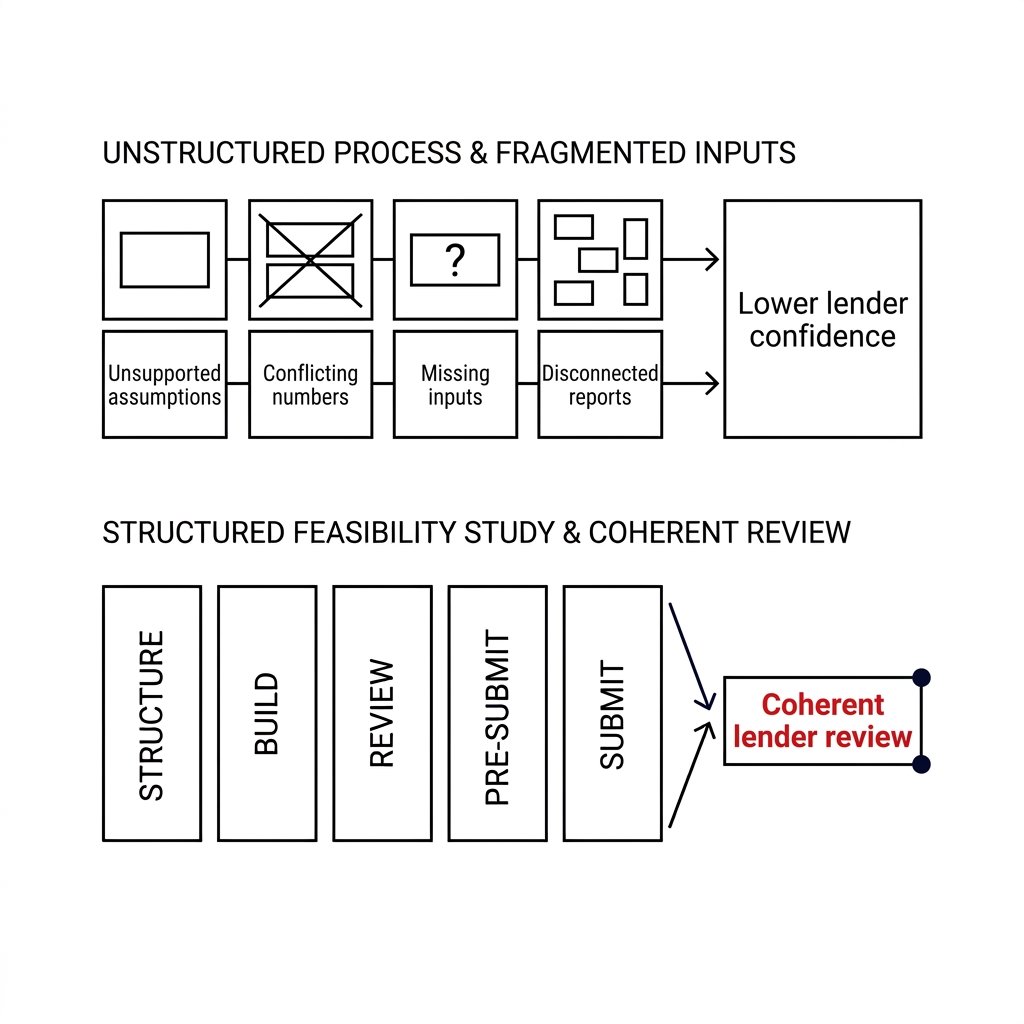
The feasibility study doesn’t exist in isolation. Lenders cross-check it against the financial model, the information memorandum, the sponsor’s track record, and the term sheet being requested. Inconsistencies — a demand forecast that doesn’t match the revenue assumptions in the model, a cost estimate that doesn’t reconcile with the capital structure — are one of the most common reasons a study gets flagged, regardless of who wrote it.
4. Assumption Transparency and Sensitivity
Reviewers don’t just read the conclusions; they interrogate the assumptions behind them. A study that presents a single base case with no sensitivity analysis, no downside scenario, and no clear sourcing for its inputs reads as either inexperienced or evasive. This is true whether the study came from an internal team or an outside firm — sloppy assumption-handling is sloppy assumption-handling either way.
Common Mistakes in Each Approach
In-house studies typically fail because of:
- Optimism bias that goes unchecked because there’s no outside party pressure-testing the numbers before submission.
- Insufficient documentation of methodology and sourcing, since internal teams often “know” the answer and skip showing the work.
- Underestimating how differently a credit committee reads a document compared to an internal stakeholder or a friendly co-investor.
External studies typically fail because of:
- Hiring a generalist consultant whose feasibility work is technically sound but sector-generic, missing the specific risk factors a specialist lender will ask about.
- Treating the study as a one-off deliverable rather than something built to align with the rest of the capital package, creating the cross-document inconsistencies described above.
- Assuming that “external” automatically equals “credible” — lenders still evaluate the consultant’s independence and track record, not just their letterhead.
Both failure modes come back to the same root cause: the study was built for the wrong audience. A document built to satisfy an internal go/no-go decision, or to check a compliance box, is not the same document an underwriter needs to see.
Consequences of Getting It Wrong
The cost of a feasibility study that doesn’t survive lender scrutiny is rarely a polite rejection. More often it shows up as:
- Extended due diligence timelines, as the lender’s technical advisors request clarifications, additional data, or a full re-scope of the study.
- Added third-party verification costs, where the lender requires an independent review of a study they don’t trust — meaning the sponsor effectively pays for the work twice.
- Credibility damage that extends beyond the specific study, since a document that reads as biased or under-researched raises questions about the rest of the sponsor’s capital package.
- In the worst cases, a quiet pass — where the lender doesn’t formally reject the deal but simply deprioritizes it in favor of sponsors whose documentation required less friction to underwrite.
None of these outcomes are about the project’s underlying merits. They’re about whether the documentation gave the lender confidence to move forward efficiently.
Principles for Deciding Between In-House and External
Rather than treating this as a binary choice, sponsors are better served by applying a few decision principles:
Match the study to its audience. If the study’s primary purpose is institutional capital raising, it needs to be built to underwriting standards from the outset — not adapted afterward from an internal document.
Weigh independence against domain knowledge. External doesn’t automatically mean better if the consultant lacks sector-specific expertise; in-house doesn’t automatically mean biased if the process includes rigorous, documented self-scrutiny and third-party validation of key assumptions.
Plan for cross-document consistency from the start. Whoever produces the feasibility study needs visibility into the financial model, the information memorandum, and the overall capital narrative — otherwise inconsistencies are almost guaranteed regardless of who does the work.
Build in assumption transparency as a structural requirement, not an afterthought. Sourcing, sensitivity analysis, and downside scenarios should be part of the study’s design, not something bolted on after a first draft is challenged.
Treat the decision as a resourcing question, not just a credibility question. In-house teams often underestimate the specialized time required to produce institutional-grade work on top of their existing responsibilities; external consultants vary enormously in cost, turnaround, and quality. The right choice depends on your team’s actual bandwidth and expertise, not a general preference for one model over the other.
Building a Feasibility Study That Holds Up
Deciding between in-house and external is only the first step. Whichever route you choose, the study still has to be structured, documented, and cross-checked in a way that survives lender scrutiny — the principles above describe what that requires, not how to execute it.
For sponsors who want a structured framework for producing a feasibility study built to lender standards, AltFin’s How to Produce a Feasibility Study That Lenders Will Not Ignore provides the implementation framework.
