How to Build a Virtual Data Room That Gets Your Project Reviewed

A Practical, Lender-Agnostic Guide for Project Sponsors and Developers
Cover of How to Produce a Feasibility Study That Lenders Will Not Ignore – institutional project finance guide for developers and sponsors

You’ve spent years developing the project. Land secured. Consultants hired. Millions already invested.

Then the lenders get access to your data room. And within ten minutes, the review quietly stops. No questions. No feedback. No explanation. Just silence.

Most developers assume rejection means something is wrong with the project.

Usually it means something else entirely: The structure of the submission failed the first screen.

Most Project Finance Submissions Fail Before Anyone Reviews  the Economics

Most sponsors believe financing decisions begin when someone opens the financial model. In reality, lenders begin with a simpler question: “Is this project worth spending time on?”

They are reviewing dozens of opportunities simultaneously under time pressure. They are not looking for reasons to approve a project. They are looking for reasons to stop reviewing it.

A disorganised Virtual Data Room creates immediate friction. Missing context. Poor sequencing. Inconsistent file naming. Multiple versions of the same document. No clear starting point.

The result is predictable. The lender assumes future due diligence will be equally difficult. The project is deprioritised or discarded before formal review begins.

Not because the project is weak. Because the submission signals execution risk.

Having the Documents Is Not the Same as Presenting Them Correctly

Many sponsors believe: “We already have everything the lender needs.”

That may be true. But lenders do not review projects document by document. They review them in a sequence.

They want to understand:

  1. What is the project?
  2. Who is behind it?
  3. Does it appear financeable?
  4. Can the claims be verified?

When information is presented in the wrong order, even strong projects become difficult to review.

The problem is rarely the quantity of information. The problem is how that information is organised.

You do not need more documents. You need the correct structure.

The Cost of Getting It Wrong

An unstructured VDR can trigger:

  • Delays during lender review
  • Repeated requests for information already provided
  • Additional scrutiny from credit teams
  • Lower confidence in sponsor capability
  • Loss of momentum during fundraising
  • Silent rejection before meaningful analysis begins

Most sponsors never discover the real reason.

Lenders rarely explain why they stopped reviewing a submission. They simply move on to the next opportunity.

Reduce Delays, Rework, and Credibility Damage Before Due Diligence Begins

Introducing the AltFin Virtual Data Room Blueprint

A Practical, Lender-Agnostic Structure Based on Real Credit Workflow Logic

The Virtual Data Room Blueprint is a practical guide that shows project sponsors how to structure a lender-reviewable VDR before approaching lenders, investors, credit committees, or advisors.

It is designed specifically for developers and sponsors preparing projects for institutional capital review.

This is not a software guide, a generic document checklist, or a project finance theory.

It is a practical framework for presenting project information in a way that reduces friction and improves review readiness.

A Properly Structured VDR Helps:

  • Reduce avoidable delays
  • Reduce document rework
  • Improve reviewer navigation
  • Improve internal lender circulation
  • Reduce credibility damage
  • Reduce preventable scrutiny
  • Improve institutional presentation quality

What’s Inside

How to Build a Virtual Data Room That Gets Your Project Reviewed
A Practical, Lender-Agnostic Blueprint for Project Sponsors and Developers Based on Credit Logic

This PDF guide provides a complete framework for building, organising, controlling, and preparing a lender-facing Virtual Data Room (VDR). It explains how institutional lenders evaluate project submissions, how information should be sequenced and presented, how project documentation should be organised, and how to prepare a VDR for external review before sharing access with lenders, investors, or credit teams.

Lender Screening & Information Sequencing Framework

A detailed explanation of how lenders assess project submissions, including the Four-Layer Sequencing Model: Orientation, Credibility, Risk & Returns, and Verification.

Includes common VDR mistakes, lender interpretations of poor document organisation, and the signals lenders associate with strong sponsor discipline.

Lender-Agnostic VDR Structure (Step-by-Step)

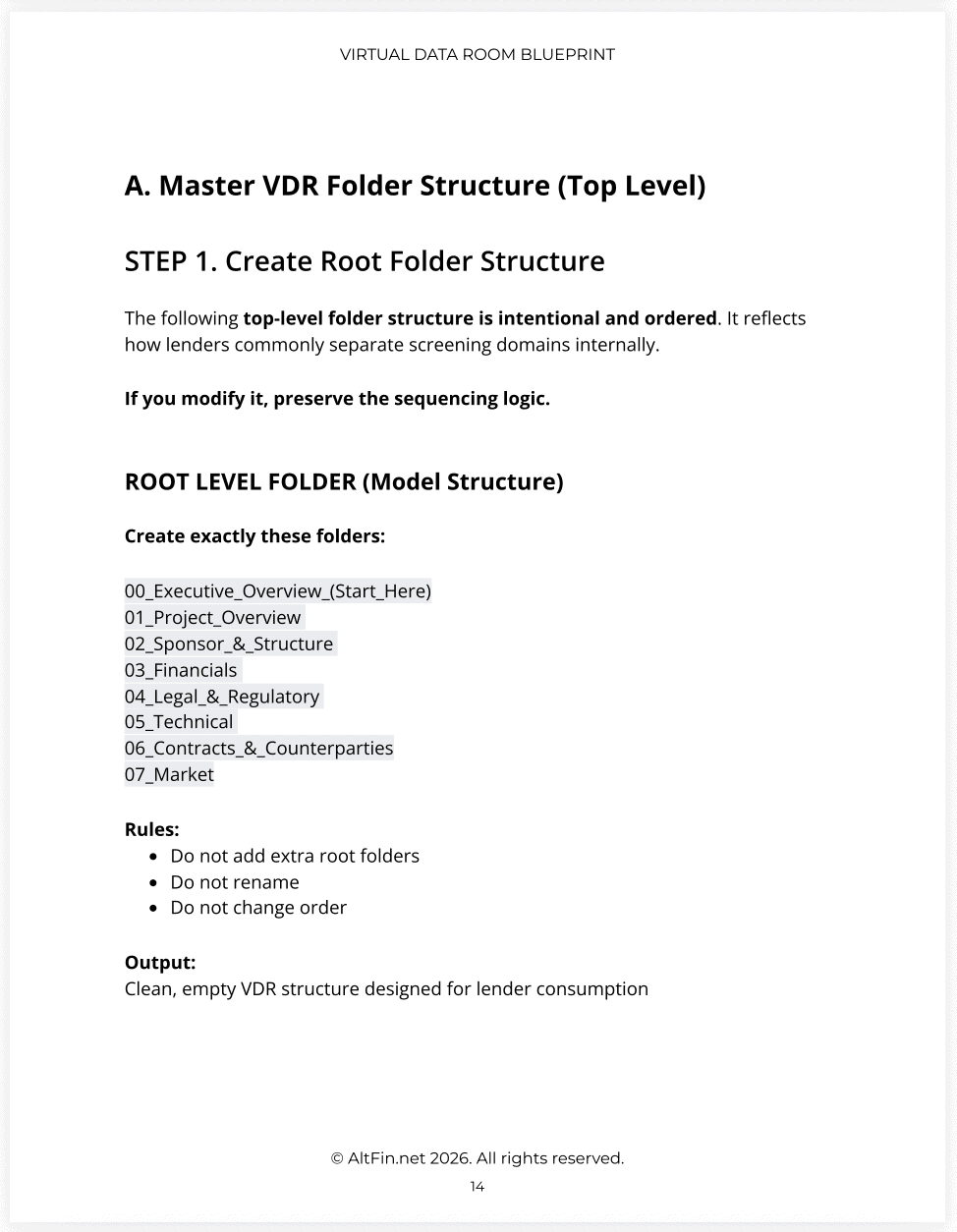
A complete Root Folder Structure aligned with common commercial lender screening behaviour, including: Executive Overview, Project Overview, Sponsor & Structure, Financials, Legal & Regulatory, Technical, Contracts & Counterparties, and Market Documentation.

A folder-by-folder VDR build process showing what documents belong in each folder, what should be excluded, how information should be sequenced, and how to structure the VDR for efficient lender review.

File Naming & VDR Finalisation

A practical framework covering file naming conventions and preparing the VDR before release, including removal of drafts, duplicate documents, internal working files, communication controls, PDF preparation standards, contact management, and final readiness checks.

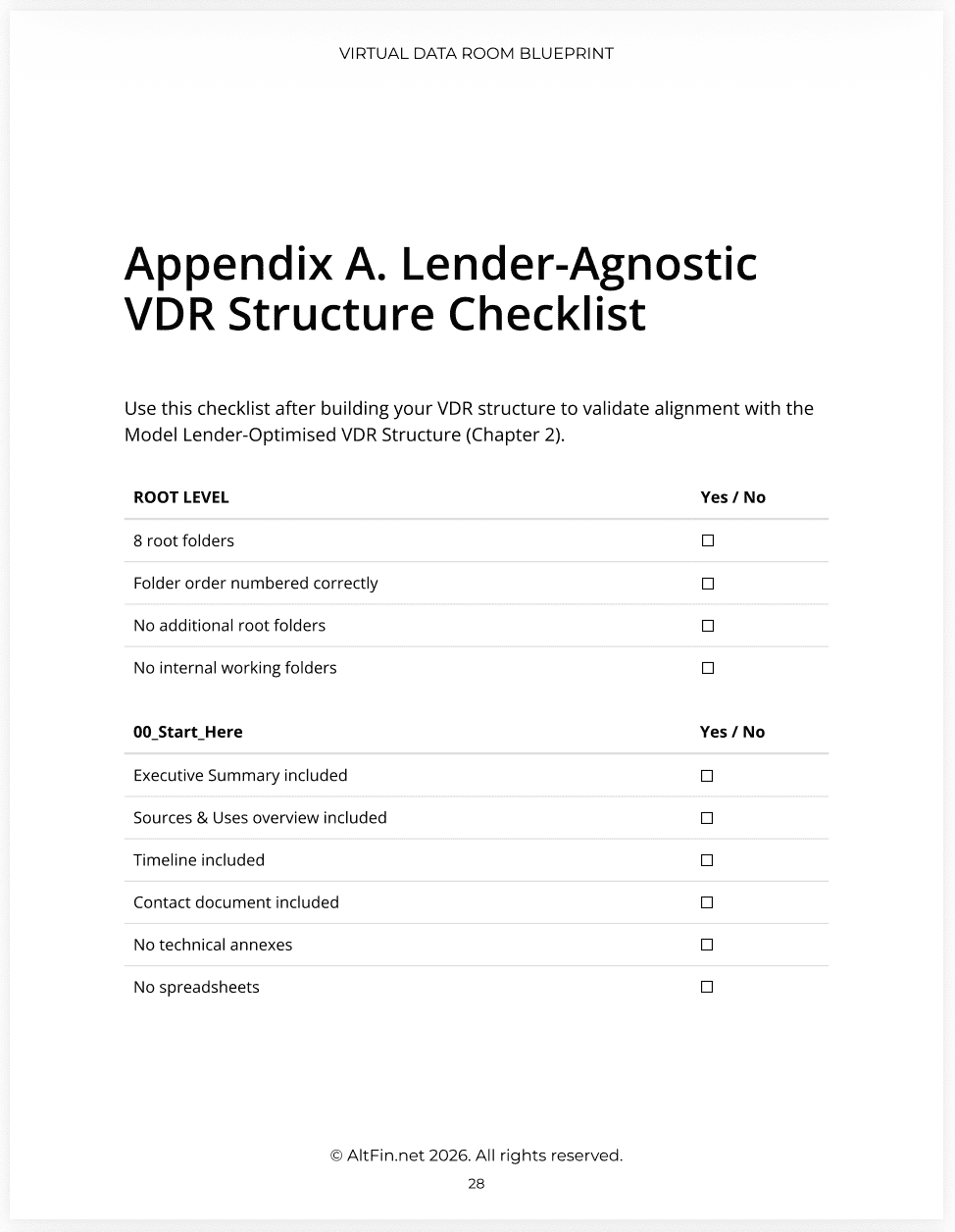
Lender-Agnostic VDR Structure Checklist

A folder-by-folder VDR validation checklist used to verify that all required documents are present, correctly organised, and aligned with the recommended lender-facing architecture.

Access, Permissions & Platform Control Checklist

A practical checklist covering platform control, reviewer permissions, information governance, release controls, and management of lender access.

Pre-Submission Checklist

A final quality-control checklist used to verify structure, document control, financial model consistency, reviewer usability, access settings, and overall VDR readiness before sharing access with lenders, investors, or credit teams.

Everything is designed to help you organise existing project documentation into a clearer, lender-facing structure.

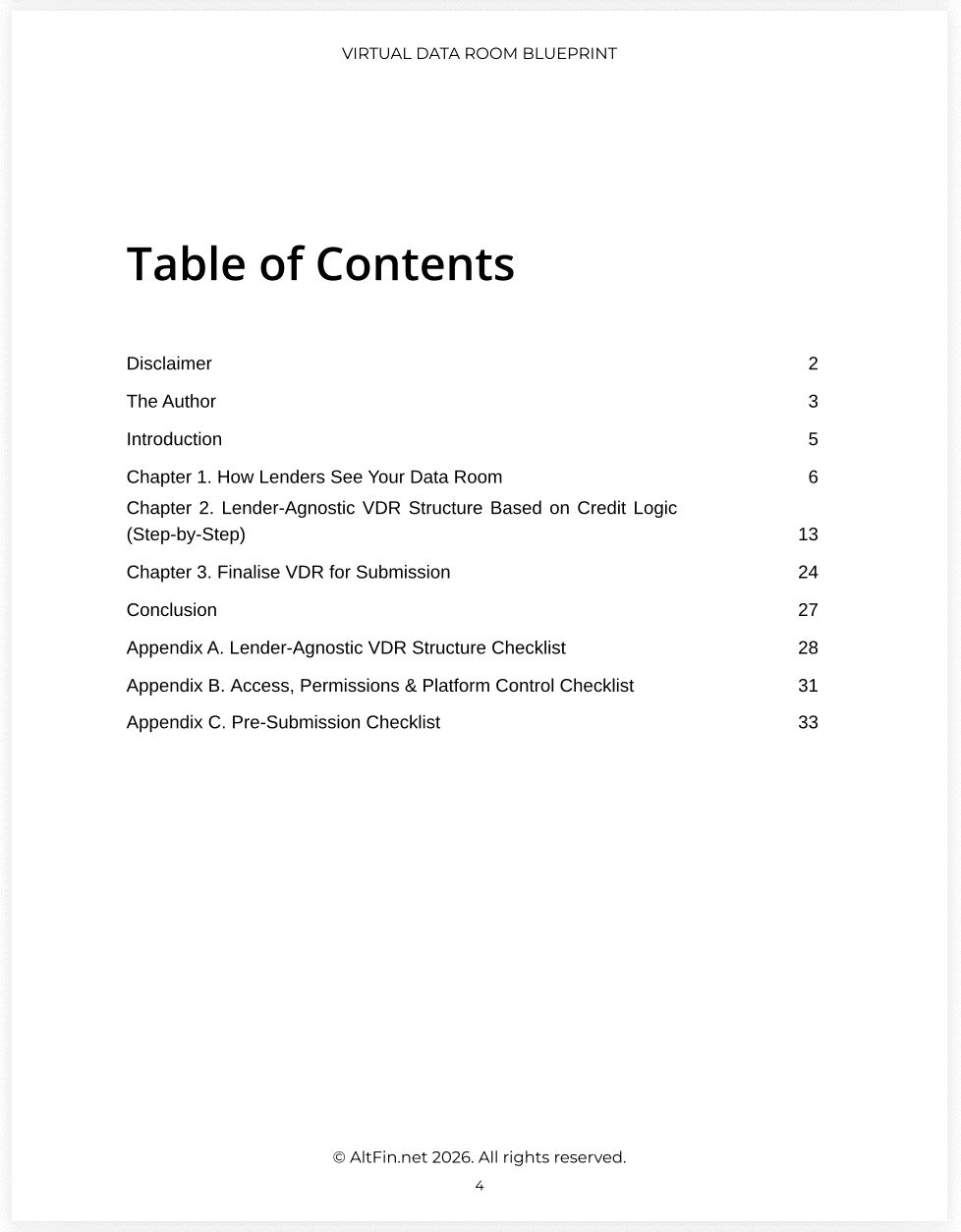
AltFin Virtual Data Room Guide - table of contents

What This Guide Helps You Avoid

Getting filtered out before credit review begins

Lenders quietly deprioritising your deal without explanation

Wasting analyst time with poor navigation

Triggering unnecessary scrutiny from credit teams

Losing momentum during fundraising

Having lenders request the same information multiple times

Signaling execution risk through disorganisation

Learning your VDR was the problem — after the deal dies

Who This Guide Is For

This guide is intended for developers and sponsors with projects in sectors such as: Infrastructure, Renewable Energy, Energy Transition, Real Estate, Hospitality, and Oil & Gas.

Particularly projects seeking finance in the $10 million to $100 million+ range.

Intended for projects that already have supporting documentation, the guide aims to help you present your project more effectively for institutional review.

What This Guide Is Not

This guide is not: a VDR tool, a generic checklist, project finance education, advisory or lender negotiation support, a capital raising strategy, or a guarantee of financing (no guide can).

Instead, it helps you:

Structure existing documents correctly

Present information for institutional review

Reduce friction before lenders open a single file

Signal execution discipline

Improve review readiness before approaching capital

It will not improve a weak project or replace legal, technical, financial, or commercial advisors.

What it can do is increase the probability your project receives what every sponsor ultimately needs:

A serious review.

Because before a project can be funded, it must first be reviewed.

And serious review is the gateway to capital.

Frequently Asked Questions

Every lender has different requirements. Will this still help?

Yes.

While lenders may have different documentation requirements, they generally evaluate submissions using similar review logic.

The guide focuses on the structural foundations that apply before lender-specific requests begin.

We already use Dropbox, Google Drive, or VDR software.

That’s not the issue.

The challenge is usually not storage.

It is sequencing, navigation, organisation, and presentation.

The framework can be applied regardless of platform.

We already have all the documents.

Most sponsors do.

The question is whether those documents are organised in a way that supports efficient lender review.

Having documents and presenting them correctly for credit review are two different things.

This sounds too basic.

Many projects encounter avoidable delays because teams underestimate operational presentation risk.

Lenders assess execution signals long before they assess detailed project risk.

Can’t our advisors handle this?

Yes.

Usually later in the process and at significantly higher cost.

This guide helps establish lender-reviewable structure before external review begins.

Will this guarantee funding?

No.

No guide can guarantee financing outcomes.

What it does is reduce preventable rejection signals before formal review begins.

Structure a VDR So Lenders Don’t Reject the Submission Before Credit Review

Know Exactly What Goes Where Before You Share the VDR