
Renewable Energy Project Finance: What Lenders Require Before Funding
Renewable energy projects often have strong market potential, proven technologies, and attractive sustainability profiles — yet many fail to reach institutional financing because they are not prepared for lender-level review.
Lenders and investors do not evaluate renewable energy projects based only on the technology or market opportunity. They assess whether the project is structured, documented, and de-risked to meet underwriting requirements.
For project sponsors developing solar, wind, energy storage, or other renewable infrastructure projects, the key question is not only “Can this project be financed?” but “Is this project prepared for lender screening?”
How Lenders Evaluate Renewable Energy Projects
Before committing capital, lenders typically assess several core areas of project readiness:
1. Revenue Structure and Offtake Certainty
Stable and predictable project revenues are central to renewable energy financing.
Lenders typically review:
- Power Purchase Agreements (PPAs) or offtake agreements
- Revenue assumptions and pricing structures
- Counterparty creditworthiness
- Market exposure and revenue risks
A strong revenue model helps demonstrate the project’s ability to generate sufficient cash flow for debt repayment.
2. Financial Model and Credit Strength
Lenders require financial models that clearly demonstrate project viability and repayment capacity.
Key considerations include:
- Capital expenditure assumptions
- Operating cost projections
- Debt service coverage
- Sensitivity analysis
- Downside scenarios
- Return expectations for equity investors
A project may have strong technical fundamentals but still face financing challenges if the financial model does not withstand lender review.
3. Due Diligence Documentation
Renewable energy projects require extensive documentation before entering lender review.
Typical requirements include:
- Feasibility studies
- Technical assessments
- Environmental and social documentation
- Permits and approvals
- Land rights and site agreements
- Engineering and construction documentation
- Commercial agreements
Missing or incomplete documentation creates uncertainty and can delay or prevent financing progress.
4. Risk Allocation and Project Structure
Lenders evaluate how project risks are identified, allocated, and mitigated.
Common areas of review include:
- Construction risk
- Technology risk
- Operational risk
- Supply chain risk
- Regulatory risk
- Market risk
Institutional financing depends on whether risks are allocated to the parties best able to manage them.
5. Collateral, Security, and Legal Enforceability
Project finance relies on clearly defined security structures.
Lenders typically examine:
- Ownership structures
- Asset security
- Project company arrangements
- Contract enforceability
- Lender rights and protections
A technically viable project may still struggle to secure capital if the legal and security framework is unclear.
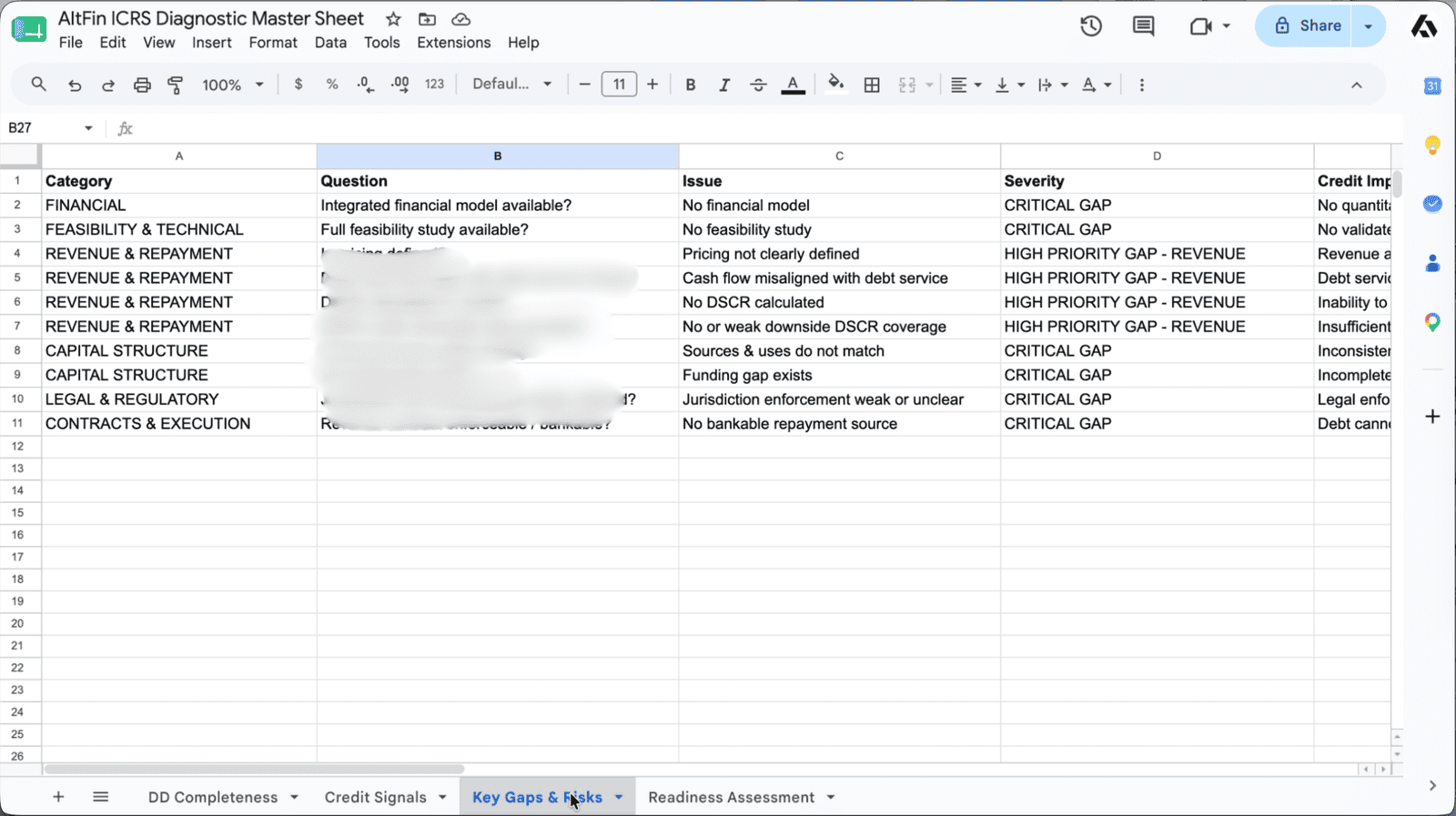
Why Renewable Energy Projects Fail Lender Screening
Many renewable energy projects do not fail because they lack potential. They fail because they are not prepared for lender evaluation.
Common issues include:
- Incomplete due diligence packages
- Weak or inconsistent financial assumptions
- Unclear capital structures
- Insufficient risk mitigation
- Poorly organised documentation
- Investment materials that do not address lender questions
Institutional capital providers need confidence that a project has been structured, documented, and prepared before entering formal financing discussions.
Get Financing Insights to Your Inbox
Why lenders go silent, stall, or pass — and how to fix it, before or during lender review.
