
Why Lenders Stop Responding
Lenders stop responding not because of poor communication, but because internal underwriters found gaps in the sponsor’s documentation or financial model that made the deal too hard to defend to committee. More follow-up won’t fix it — closing those credibility gaps will.
If a lender who once seemed engaged has gone quiet — fewer replies, longer gaps, vague “we’re reviewing internally” messages, or outright silence after a call that felt positive — the instinct is to treat it as a communication breakdown. Send a follow-up. Try a different contact. Escalate to a senior banker. In most cases, none of that fixes anything, because communication was never the actual problem.
Lenders do not go silent because they forgot to reply. They go silent because something in the deal has made it harder to say yes than to say nothing. Silence is usually the lender’s way of avoiding a difficult conversation about weaknesses they’ve already identified but haven’t decided how — or whether — to raise.
This page explains why that happens, how lenders actually process a sponsor’s request internally, the mistakes that most often trigger disengagement, and the principles that keep a deal moving through to a decision.
The Real Reason Lenders Go Quiet
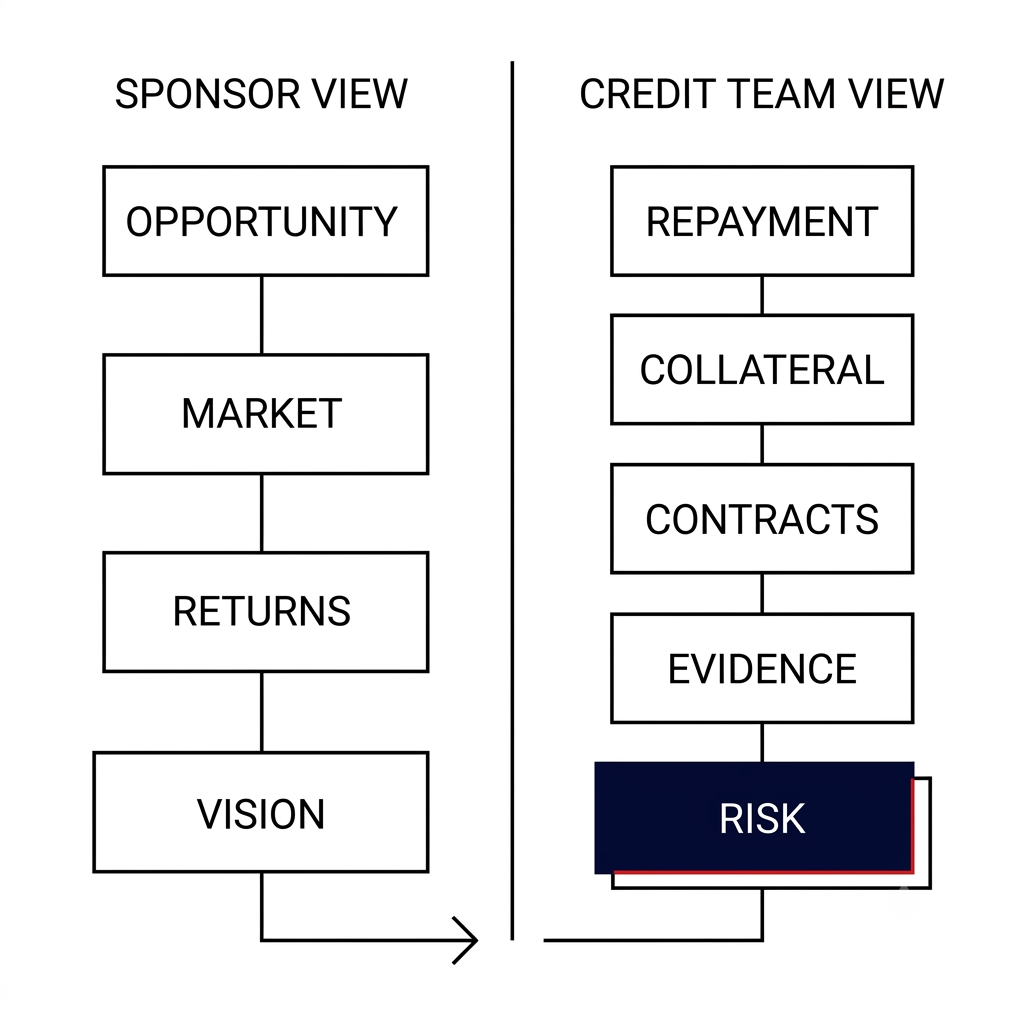
A lender’s internal process runs on conviction, not politeness. Every deal that enters a credit or investment committee pipeline has to be defended by someone inside the institution — a deal team member, an underwriter, a relationship manager — to their own colleagues, risk function, and committee. That internal advocate needs a credible, well-supported story to tell.
When the sponsor’s documentation, financial model, or track record leaves gaps, that internal advocate has three options: ask the sponsor pointed questions, quietly deprioritize the deal in favor of one that’s easier to defend, or shelve it without explanation. Lenders overwhelmingly choose the second or third path, because asking hard questions directly can feel confrontational, and because most lenders manage a pipeline of competing opportunities and simply reallocate attention toward whichever deal requires the least internal friction.
From the sponsor’s side, this looks like unresponsiveness. From the lender’s side, it’s a rational allocation of limited underwriting capacity toward the deals most likely to survive committee scrutiny.
How Lenders Actually Evaluate a Sponsor
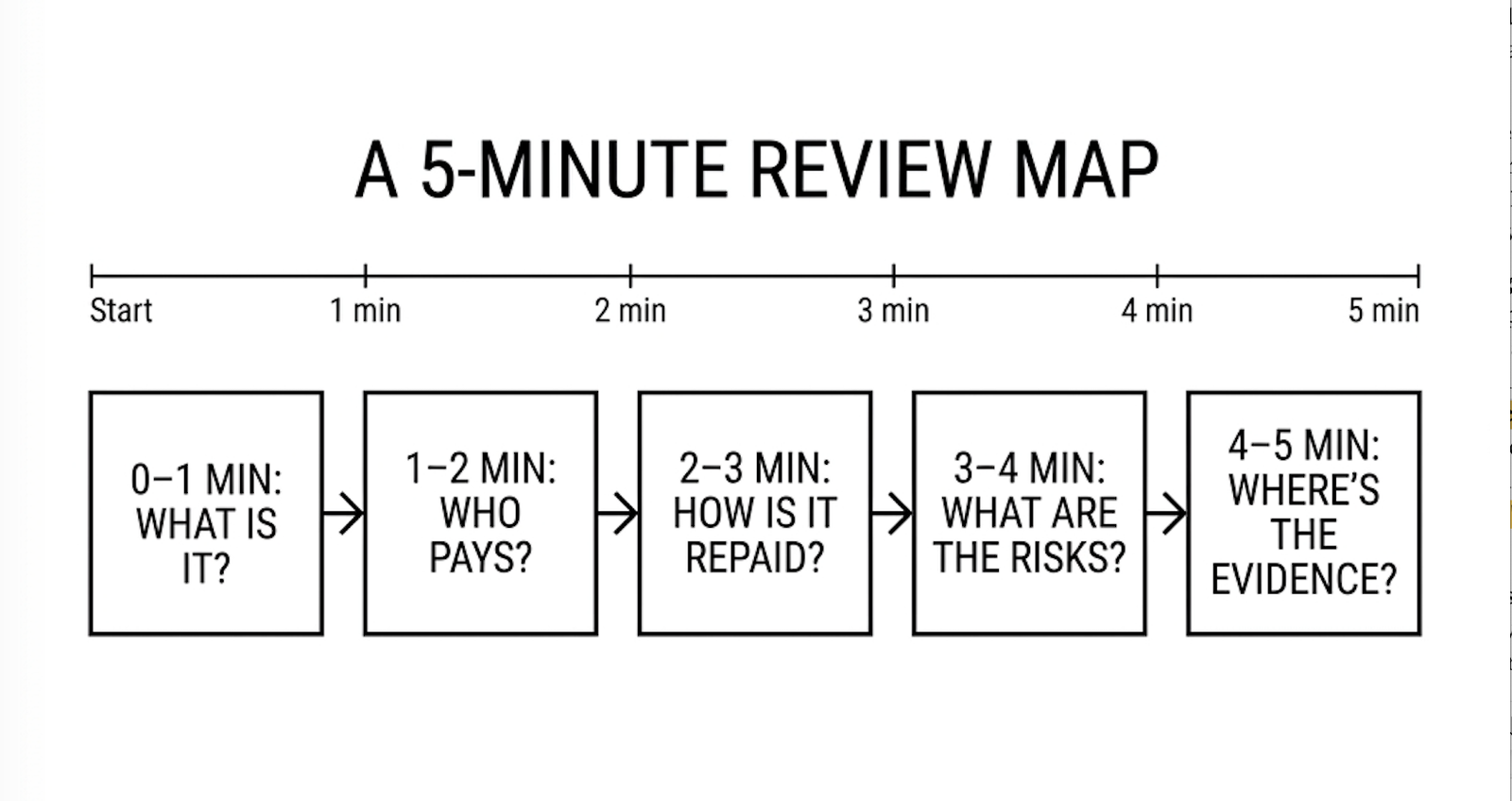
Retail and relationship-based lending relies heavily on personal trust and ongoing dialogue. Institutional capital does not work that way. Lenders — banks, credit funds, infrastructure debt funds, insurance-linked capital — evaluate opportunities through a structured, largely internal process where the sponsor is often not in the room for the parts of the process that matter most.
Three dynamics define this process:
The documentation has to do the persuading, not the sponsor. Once a deal moves past an initial conversation, it advances almost entirely on the strength of what’s on paper: the information memorandum, the financial model, supporting technical and legal documentation, and the data room. A sponsor’s charisma on a call cannot compensate for weak documentation once the deal is being reviewed by people who never spoke to the sponsor directly.
Underwriters look for reasons to say no before they look for reasons to say yes. This is a structural feature of risk management, not a personal judgment about the sponsor. Committees are measured on the quality of the deals they approve, not the volume, so the default posture is skepticism. A deal has to actively overcome that skepticism; it doesn’t get the benefit of the doubt.
Readiness is judged holistically, not point-by-point. Lenders are not just checking whether a data room is “complete.” They’re forming a composite judgment about whether the sponsor understands their own project as well as the capital provider needs them to, whether the numbers are internally consistent, and whether engaging further is worth the underwriting cost. A single missing document rarely kills a deal. A pattern of imprecision, inconsistency, or unresolved questions does.
Common Mistakes That Cause Lenders to Disengage
Most sponsors who experience lender silence are making one or more of the following mistakes, often without realizing it:
- Treating the first conversation as the close, not the opening. Sponsors frequently invest heavily in the pitch and relationship-building stage, then respond slowly or thinly when the lender’s underwriting team asks for supporting detail. The energy needs to be reversed: the pitch gets you a first conversation, the documentation gets you a decision.
- Submitting a financial model that can’t withstand scrutiny. Models with unexplained assumptions, inconsistent formulas, or numbers that don’t reconcile across statements are one of the fastest ways to lose credibility. Once an underwriter finds one unreliable number, they reasonably question all of them.
- Confusing enthusiasm with evidence. Statements like “there is strong demand” or “the technology is proven” carry no weight without the underlying data, contracts, or third-party validation to support them. Lenders discount unsupported claims automatically.
- Under-preparing for the questions lenders actually asks. Sponsors often prepare for questions about the project’s merits and are caught flat-footed by questions about governance, downside scenarios, counterparty risk, or their own track record — the questions that determine whether a deal is fundable, not just whether it’s interesting.
- Presenting an incomplete or disorganized data room. A data room that is hard to navigate, missing standard documents, or inconsistent in version control signals a level of operational maturity that gives underwriters a reason to pause rather than proceed.
- Mistaking interest for commitment. A lender expressing interest in learning more is not the same as a lender committing to allocate underwriting resources. Sponsors who don’t distinguish between the two often over-invest time in the wrong relationships and under-invest in the documentation that would move a genuinely interested lender forward.
What It Costs Sponsors Who Don’t Address This
The consequences of unresolved credibility or documentation gaps compound over time, and rarely announce themselves as a single, obvious failure:
- Deals stall in an undefined middle state. Rather than a clear rejection, sponsors are left in an ambiguous holding pattern — a state that’s costly because it delays the decision to fix the underlying issue or approach a different capital source.
- Reputational cost with the same lender is quiet but real. Institutional credit markets are smaller and more networked than they appear. A sponsor who approaches the same lender again with the same unresolved weaknesses is often recognized, and the second silence tends to come faster than the first.
- Time spent chasing unresponsive lenders is time not spent fixing the underlying issue. Sponsors frequently spend months trying to re-engage a lender through follow-up emails and calls rather than addressing the documentation or positioning gap that caused the disengagement in the first place — the only intervention that reliably changes the outcome.
- Repeated cycles erode a sponsor’s own confidence and narrative. Each unexplained rejection makes the next pitch slightly less convincing, because sponsors start to internalize uncertainty about their own project rather than correcting a fixable, structural gap in how it’s presented.
Principles for Staying Engaged Through the Full Underwriting Process
Assume every document will be read without you in the room. Write and structure materials so that a stranger inside the lending institution — who has never spoken to you and won’t get to ask you a clarifying question in real time — can follow the logic and reach a favorable view unaided.
Match your level of preparation to the size of the request. Capital requests should be backed by institutional-grade documentation. If the ask is large, the supporting evidence, financial rigor, and governance detail need to be proportionate.
Get ahead of the questions a lender hasn’t asked yet. The sponsors who keep momentum are the ones who anticipate the diligence questions underwriters typically raise and address them proactively in the documentation, rather than waiting to be asked and then scrambling to respond.
Treat internal consistency as non-negotiable. Every number, assumption, and claim across the information memorandum, model, and data room needs to reconcile. Inconsistencies — even minor ones — are read as a signal about the reliability of everything else in the package.
Read silence as a signal to diagnose, not a signal to chase. When a previously engaged lender goes quiet, the more productive response is usually an honest audit of the documentation and readiness gaps that may have caused it, not a heavier cadence of follow-up messages.
Separate the sponsor’s story from the sponsor’s evidence. A compelling narrative earns attention. Verifiable evidence — audited or reviewed financials, signed contracts, third-party technical reports, a track record that can be checked — earns capital. Both are necessary, and neither substitutes for the other.
Where to Go From Here
Understanding why lenders disengage is the first step. Fixing it requires an honest, structured diagnosis of where a specific sponsor’s documentation, financial model, and positioning create friction for an underwriter — and a disciplined process for closing those gaps before they cost another deal.
Sponsors who want a structured framework for that diagnosis and remediation can find it in AltFin’s Capital Readiness System.
