
Why Projects Get Rejected by Lenders Before Review
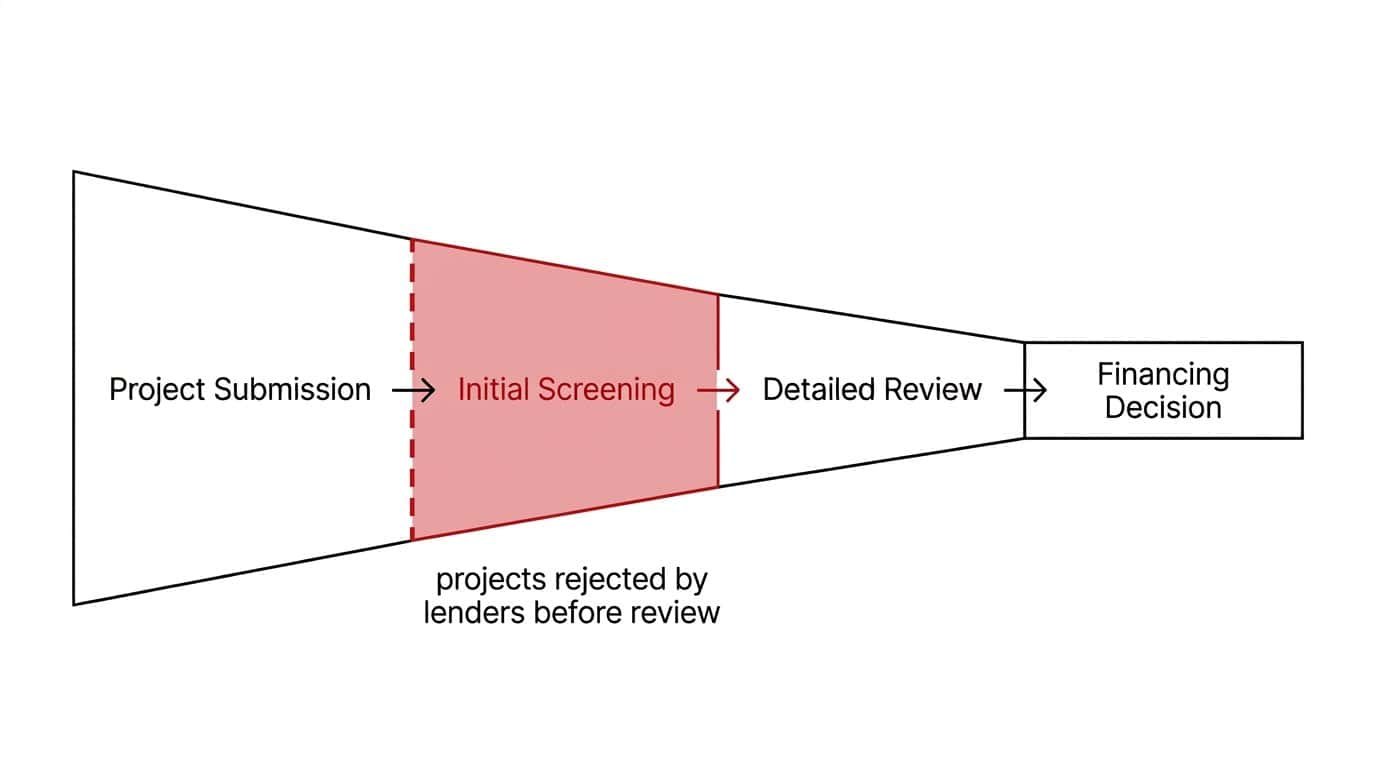
A project can be rejected by a lender before meaningful due diligence begins—not necessarily because the underlying opportunity is poor, but because the lender cannot establish quickly enough that the project is sufficiently credible, financeable, and reviewable.
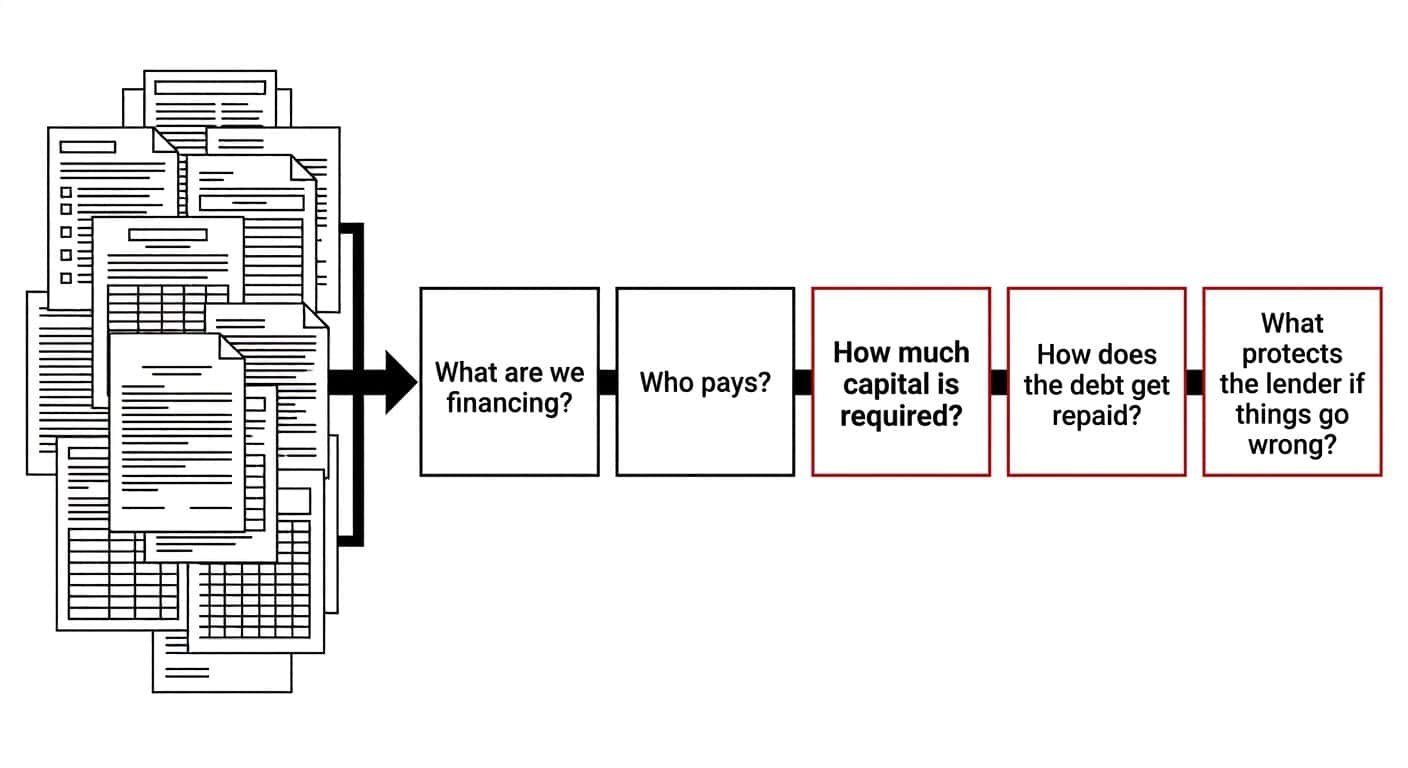
Institutional lenders screen for fundamental issues before committing significant underwriting resources. They need to understand what is being financed, how debt will be repaid, who is responsible for delivery, what risks could impair repayment, how those risks are allocated or mitigated, and whether the supporting evidence is credible. If those questions cannot be answered from the initial submission, the project may not progress to substantive review.
This is why having a large amount of documentation is not the same as being ready for institutional lender review.
What “Rejected Before Review” Actually Means
“Rejected before review” does not always mean that a formal credit committee has declined the project. In many cases, it means the opportunity does not progress into meaningful underwriting because an initial screening identifies problems significant enough to stop further work.
Institutional lenders have limited underwriting capacity. They therefore need an early basis for deciding whether a transaction warrants deeper analysis.
That initial screen can expose problems such as:
- an unclear financing requirement;
- an implausible or insufficiently supported repayment path;
- weak or uncertain project economics;
- inadequate sponsor capability;
- unresolved legal or contractual issues;
- insufficient security or unclear collateral rights;
- material technical or execution uncertainty;
- incomplete or inconsistent information;
- unsupported financial assumptions;
- material environmental or social risks that have not been addressed.
These are not merely documentation problems. They can indicate underlying credit, execution, legal, commercial, or risk-allocation problems.
How Institutional Lenders Evaluate a Project
1. Lenders assess whether the project makes commercial sense
Lenders ultimately need confidence that the project can generate the cash flow required to meet its obligations.
In project finance, the project’s own cash flows are central to repayment analysis. Lenders examine whether projected operating cash flows can cover operating requirements and debt service with an appropriate margin, including under less favourable conditions. (World Bank)
A sophisticated financial model therefore does not compensate for weak underlying economics. If the revenue assumptions, costs, market position, contracts, or operating assumptions are not credible, the model simply makes the uncertainty more visible.
2. Capital providers assess the sponsor and project counterparties
The people and entities responsible for developing, constructing, owning, and operating the project matter to credit risk.
Institutional assessment can include the sponsor’s experience, financial capacity, reliability, and ability to meet obligations associated with the project. World Bank guidance identifies the project sponsor as one of the key areas considered in assessing bankability. (World Bank)
A strong project concept does not eliminate concerns about whether the parties responsible for delivering it can actually execute.
3. Lenders examine risk allocation
Lenders do not simply ask whether risks exist. They ask who bears them, whether the allocation is contractual, and whether the party carrying the risk is capable of managing it.
Construction risk, completion risk, market risk, operating risk, regulatory risk, input-cost risk, offtake risk, and other material risks can affect the project’s ability to repay debt.
Bankability therefore depends not only on projected returns but also on how risks are allocated and mitigated. (PPP Resource Center)
4. Capital providers test legal and contractual foundations
A project’s financial case depends on enforceable rights and obligations.
Lenders may need confidence in matters such as project ownership, land rights, permits, material contracts, revenue arrangements, security interests, and the enforceability of relevant agreements.
A commercially attractive project can therefore remain unsuitable for financing if its legal foundation is incomplete or uncertain.
5. Lenders examine technical and execution feasibility
The project must be capable of being built and operated as represented.
Institutional appraisal can involve assessment of technical feasibility, project implementation capability, contractors, management systems, and other execution-related matters. IFC, for example, describes appraisal as an assessment of the investment’s business potential, risks, opportunities, and ability to meet applicable standards. (IFC)
The question is not simply whether the technology exists. It is whether the proposed project can realistically be delivered at the stated scale, cost, schedule, and operating assumptions.
6. Lenders assess environmental and social risks where applicable
Environmental and social considerations can form part of institutional project appraisal rather than being an issue addressed only after financing interest has been established.
IFC’s project cycle includes assessment of environmental and social compliance, while its due-diligence processes can involve detailed review of project-specific environmental and social risks. (IFC)
For projects exposed to significant environmental or social risks, unresolved issues can therefore affect whether the transaction progresses.
Why Projects Fail the Initial Screen
The financing request is unclear
A lender needs to understand what capital is actually being requested and what the proposed financing is intended to accomplish.
If the funding requirement, capital structure, timing, or repayment concept is unclear, the lender has difficulty determining whether the proposed transaction can be evaluated on a credit basis.
The repayment story is weak
A project can have an attractive narrative while still lacking a sufficiently credible repayment mechanism.
Common warning signs include:
- revenue assumptions without adequate supporting evidence;
- dependence on uncertain future events;
- insufficient operating margin;
- unrealistic cost assumptions;
- excessive reliance on refinancing or asset appreciation;
- mismatches between debt tenor and project cash flows.
The central question remains straightforward: where will the money to repay the lender come from?
The evidence does not support the claims
Statements about market demand, contracts, costs, construction schedules, permits, technology, or revenues need appropriate supporting evidence.
A lender does not assess the quality of a project solely from what the sponsor says about it. The underlying evidence must support the conclusions being presented.
Information is incomplete or contradictory
A project may contain substantial documentation while still producing a poor initial impression if important information conflicts across documents.
For example, inconsistent project costs, capacity figures, ownership information, timelines, revenue assumptions, or financing requirements can create uncertainty about which version is reliable.
The problem is not simply missing paperwork. It is reduced confidence in the information as a whole.
The submission is difficult to review
Institutional lenders need to work efficiently through large amounts of information.
If critical evidence is difficult to locate, duplicated, outdated, poorly labelled, or disconnected from the claims being made, the review becomes slower and more uncertain.
This is why information quality includes structure, consistency, traceability, and usability, not just document volume. (AltFin)
Material risks have no credible mitigation
Identifying a risk is not the same as addressing it.
If a project depends on a major permit, construction contractor, offtake agreement, technology assumption, regulatory condition, or other critical dependency, the lender needs to understand its status and how the associated risk is controlled.
Unresolved material risks can prevent a transaction from progressing even when the overall opportunity appears attractive.
Common Sponsor Mistakes
Mistake 1: Sending everything
More information does not automatically create more confidence.
An unstructured collection of documents can make it harder for a reviewer to establish what is current, relevant, authoritative, and material.
Mistake 2: Leading with the opportunity instead of the credit case
Sponsors naturally focus on the project’s potential.
Lenders focus on whether the proposed financing can withstand risk and whether debt repayment is sufficiently supported.
The project story matters, but it must connect to the underlying credit case.
Mistake 3: Treating the financial model as proof
A model is an analytical representation of assumptions. It is not independent evidence that those assumptions are correct.
Critical assumptions need credible support from the project’s commercial, technical, legal, and operational evidence.
Mistake 4: Assuming due diligence will fix the gaps
Due diligence is designed to investigate and validate a transaction—not to substitute for basic project preparation.
If fundamental information is missing or material structural issues remain unresolved, deeper diligence may never begin.
Mistake 5: Approaching more lenders instead of diagnosing the problem
When multiple lenders respond with delays, repeated information requests, limited engagement, or no clear progression, the problem may not be the number of lenders being approached.
It may indicate that the project has unresolved readiness issues.
What Happens When the Problem Is Not Addressed
The immediate consequence may simply be silence or a request for more information.
But the practical effects can accumulate:
- lender review takes longer;
- due-diligence requests multiply;
- internal questions become harder to answer consistently;
- transaction costs increase;
- financing timelines extend;
- sponsor credibility can suffer;
- opportunities can be lost because capital is not available when required.
Most importantly, the sponsor may not know which underlying issue is causing the problem.
A lender may simply decide not to proceed rather than provide a detailed diagnosis of every weakness identified during preliminary screening.
How to Reduce the Risk of Rejection Before Review
The objective is not to make a project appear stronger than it is.
The objective is to make the project’s actual position clear, supportable, internally consistent, and capable of institutional examination.
Before approaching institutional lenders, sponsors should be able to answer, with supporting evidence:
- What exactly is being financed?
- How much capital is required and why?
- How will the debt be repaid?
- What are the material risks to repayment?
- Who bears those risks and how are they mitigated?
- Who is responsible for delivering and operating the project?
- What contractual and legal rights support the transaction?
- What evidence supports the project’s commercial, technical, and financial assumptions?
- Is the information consistent across the submission?
- Can an institutional reviewer understand the project without having to reconstruct the case from scattered information?
These principles do not guarantee financing. They reduce avoidable uncertainty and make it easier for a lender to determine whether the opportunity merits deeper review.
The Key Principle
Institutional lenders are not looking only for a promising project.
They are looking for a project whose risk, repayment logic, legal foundation, execution capability, and supporting evidence can withstand institutional scrutiny.
That distinction explains why a project with extensive documentation can be rejected while a less complicated project progresses: the question at the initial stage is not how much information exists, but whether the information provides a sufficiently credible basis for further underwriting.
If You Need a Structured Way to Address the Problem
If you want to move from understanding the problem to systematically assessing and preparing your project for institutional lender review, AltFin’s Institutional Capital Readiness System (ICRS) provides a structured, lender-agnostic implementation framework for project sponsors and developers.
