
15 Red Flags That Make Institutional Lenders Disappear
Summary: The 15 Red Flags
- A financial model that isn’t independently stress-tested
- Permitting presented as “in progress” without a verifiable timeline
- Use of proceeds that shifts between documents
- Sponsor equity that doesn’t match what was represented
- Revenue assumptions without independent corroboration
- No independent, bankable feasibility study
- Unclear land rights, title, or legal structure
- No demonstrated execution track record
- A data room that’s incomplete or inconsistent across versions
- A capital request that doesn’t match the project’s stage
- No credible repayment or exit mechanism
- Unresolved environmental or social risk
- Slow or inconsistent responses during diligence
- Broker chains that obscure who the real sponsor is
- Undisclosed history of failed deals or litigation
Each one turns a risk institutional underwriting could otherwise measure into one it can’t — which is why lenders tend to quietly stop engaging rather than issue a formal decline.
You had a promising call. The lender seemed interested. Maybe you sent over a deck, a financial model, a term sheet request. Then — nothing. No rejection, no explanation, just silence.
Sponsors usually assume a lender who goes quiet has simply moved on to other deals. Often something more specific happened. This pattern — a lender disengaging rather than issuing a formal decline — is documented across lending markets generally: rather than communicate an unfavorable finding, the party handling the file simply stops responding. In institutional capital raising specifically, that silence is rarely random. Institutional lenders run structured, document-driven due diligence built to filter out deals rather than negotiate them into shape, and only a small fraction of the projects that enter that process ever reach financial close. When an underwriting team finds a disqualifying issue partway through, the file is far more likely to be quietly deprioritized than formally declined.
This article covers the 15 issues that most reliably stall or end institutional engagement on capital-intensive real-asset projects — infrastructure, energy, and real estate. For each one: why it exists as an underwriting concern, how lenders actually evaluate it, and what getting it wrong costs a sponsor.
Why Institutional Due Diligence Is Built to Filter, Not Negotiate
Project finance was developed specifically as a risk-mitigation structure, and nearly every element of institutional underwriting — the financial model, the independent feasibility study, the legal due diligence, the sponsor background check — exists to convert unknown risk into known, quantifiable risk before capital commits. Lenders are not averse to risk itself; they are averse to risk they cannot measure. A file that raises questions the lender cannot resolve doesn’t get a rejection letter — it gets filed as “not yet ready” and stops receiving attention.
That single distinction — known risk versus unknown risk — explains most of what follows. Each red flag below is a way a sponsor unintentionally turns a measurable risk into an unmeasurable one.
The 15 Red Flags
1. A Financial Model That Isn’t Independently Stress-Tested
Lenders don’t evaluate a model on whether the base case is attractive. A model is only considered credible when it demonstrates the project can service debt under adverse conditions — lower pricing, delayed construction, rate movement — not just the sponsor’s target scenario. Institutional credit teams routinely rebuild or independently stress-test sponsor models rather than accepting them as submitted. A model that hasn’t already been stress-tested by the sponsor signals that the underlying assumptions haven’t been pressure-checked, and once the numbers are in doubt, the rest of the file loses credibility with them.
2. Permitting Presented as “In Progress” Without a Verifiable Timeline
Permitting delays are one of the most consistent sources of cost overrun and schedule risk in infrastructure and energy projects; multi-year permitting delays with double-digit cost escalation are well documented across the sector, and some large projects have required well over a hundred separate permits across multiple agencies. Lenders distinguish sharply between an approval that is documented and one that is merely expected. A sponsor who cannot produce evidence of permitting status, or who cannot say precisely which approvals remain outstanding and why, reads as either unprepared or genuinely not at a financeable stage yet.
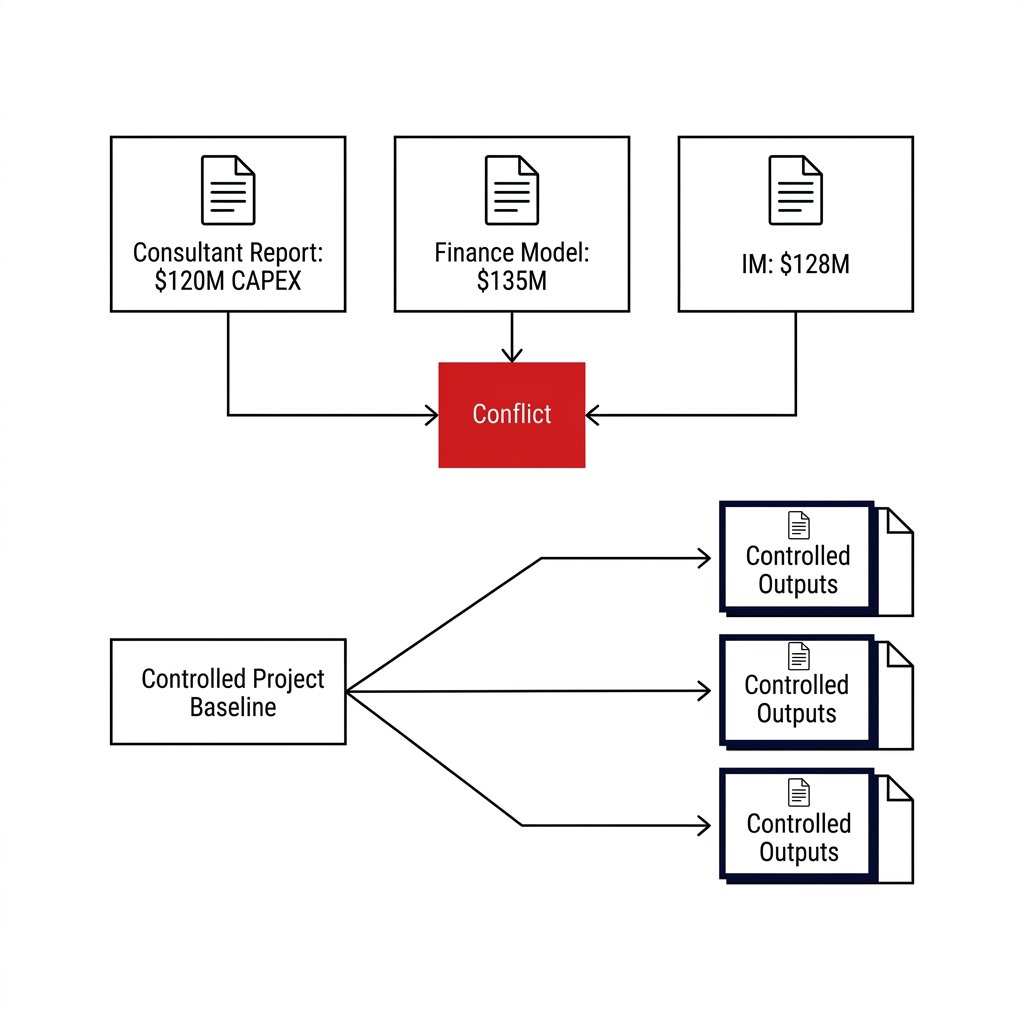
3. Use of Proceeds That Shifts Between Documents
Financial institutions are required to monitor whether a customer’s stated purpose is consistent with their profile and prior representations, and an unexplained inconsistency is a recognized red flag under standard know-your-customer practice. When the stated use of financing shifts between the deck, the model, and the term sheet request, it raises the same category of concern — not necessarily fraud, but a file that no longer matches its own story. Most of the time this happens because documents were updated separately over months rather than any bad intent, but the lender has no way to distinguish carelessness from misrepresentation from the outside.
4. Sponsor Equity That Doesn’t Match What Was Represented
Deals with no sponsor equity generally don’t get funded, and deals with thin equity stand very little chance. Lenders expect real capital at risk from the sponsor — not soft commitments, letters of intent, or equity that is contingent on the loan closing first — because a project financed entirely with third-party capital creates weak alignment between the people managing it and the institution carrying the risk. When the actual sponsor contribution turns out to be smaller, later, or more conditional than what was originally represented, it changes the lender’s risk calculus regardless of how strong the asset itself is.
5. Revenue Assumptions Without Independent Corroboration
Lenders look for evidence a revenue stream is contracted and reliable, not merely modeled — long-term offtake agreements or power purchase agreements with creditworthy counterparties are the standard reference point in energy and infrastructure finance specifically because they convert projected revenue into contracted revenue. Sponsor-generated forecasts that aren’t backed by signed offtake agreements, independent market studies, or comparable transaction data are treated as unproven, no matter how detailed the spreadsheet looks.
6. No Independent, Bankable Feasibility Study
A feasibility study only counts as “bankable” to institutional lenders when it meets a specific bar: it must be prepared by a party with no financial stake in the outcome, every assumption must be sourced and verifiable rather than asserted, the numbers must be internally consistent, and the model must demonstrate the project survives adverse conditions. A study missing any of these — or a sponsor-authored feasibility assessment with no independent party behind it — is treated as a structural gap, not a minor omission, because it means the core technical and market risk of the project has never been tested by anyone outside the sponsor’s own team.
7. Unclear Land Rights, Title, or Legal Structure
Legal due diligence on title, land rights, and corporate structure is standard practice specifically because unresolved issues here are expensive and slow to fix after money has moved. Lenders’ legal teams typically require a clean, current title report or certificate of title before they will rely on the asset as security. A sponsor who cannot produce a clear ownership and rights chain — including joint venture terms and any encumbrances — is signaling that legal diligence on this deal is likely to be long, contested, or unresolvable, whether or not that’s the intent.
8. No Demonstrated Execution Track Record
Institutional lenders weight the sponsor’s history as heavily as the asset itself. Underwriting standards commonly look for a documented record of comparable completed projects — how many, how recently, in what role, and how each one was ultimately exited or refinanced — with consistency in the management team behind those projects. A sponsor with a strong asset on paper but no verifiable record of having delivered something comparable raises a direct question about whether the project can actually be executed as modeled, and that question is disproportionately weighted for first-time sponsors.
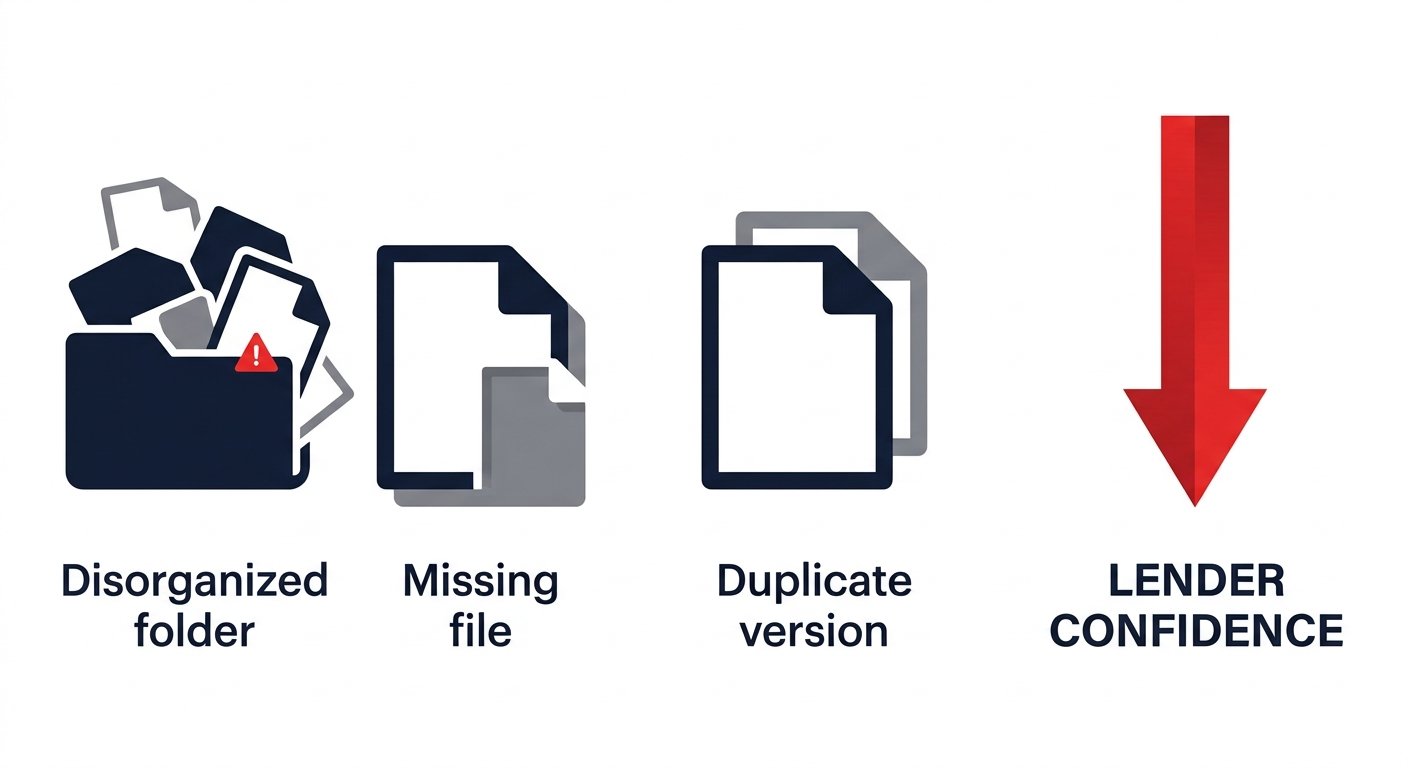
9. A Data Room That’s Incomplete or Inconsistent Across Versions
Institutional diligence is document-driven, and a disorganized data room — missing files, conflicting versions, information that has to be chased down — slows the process and signals operational weakness independent of the underlying deal quality. Lenders and diligence teams routinely treat data room discipline as a preview of what post-closing reporting and covenant compliance will look like, which means the cost of a messy data room extends well beyond the time it wastes.
10. A Capital Request That Doesn’t Match the Project’s Stage
Lenders calibrate structure and pricing to where a project actually sits — pre-development, construction-ready, or operational — and risk appetite shifts sharply between those stages. A request that assumes construction-stage terms for a project still working through permitting, or that seeks full project financing before feasibility is locked in, signals either inexperience with how institutional capital is structured or a fundamental misread of the project’s own readiness. This mismatch is one of the fastest ways a file gets set aside as premature rather than actively evaluated.
11. No Credible Repayment or Exit Mechanism
Lenders need a specific, evidenced answer to how the facility gets repaid or refinanced — not a general intention. In transactions with a defined exit (sale, refinancing, takeout financing), lenders increasingly expect documentation supporting that exit: a listing agreement, a signed offtake or purchase contract, or a takeout lender’s indicative terms, rather than a narrative alone. A sponsor whose repayment story is “we’ll refinance once it’s operational,” without evidence supporting who would refinance it and under what terms, leaves the lender to build that case themselves — something institutional credit teams are generally unwilling to do on a sponsor’s behalf.
12. Unresolved Environmental or Social Risk
For project finance above roughly $10 million in capital cost, environmental and social risk screening is now standard practice among internationally active lenders under frameworks like the Equator Principles, which over a hundred financial institutions across dozens of countries have formally adopted. Projects are categorized by the scale of their environmental and social impact, and higher-risk categories trigger independent impact assessments and ongoing monitoring covenants. Environmental liabilities or community opposition that surface during diligence — rather than being disclosed by the sponsor upfront — are treated as a disclosure failure on top of the underlying risk itself.
13. Slow or Inconsistent Responses During Diligence
Responsiveness during the application and diligence process functions as its own signal. Lenders and diligence teams commonly describe slow, inconsistent, or unclear responses to routine questions as a leading indicator of how the relationship will function after funding — since the same organizational capacity being tested during diligence is what the lender will depend on for years of post-closing reporting and covenant compliance.
14. Broker Chains That Obscure Who the Real Sponsor Is
When a deal reaches a lender through several layers of unrelated intermediaries — sometimes called a “daisy chain” in lending — with no clear line back to a sponsor who is aware of and can confirm the terms being discussed, it functions as a structural red flag independent of the underlying project’s merits. It raises a direct question about whether the lender is actually negotiating with the party who controls the decision, and that uncertainty alone is often enough to end engagement, regardless of how strong the deal looks on paper.
15. Undisclosed History of Failed Deals or Litigation
Reputational and background checks on sponsors are standard practice in institutional underwriting. A prior failed transaction or litigation history is not automatically disqualifying on its own — lenders understand that projects fail for legitimate reasons. What tends to be disqualifying is the lender discovering it independently rather than hearing it disclosed by the sponsor upfront, because it reframes everything else in the file as something that may also have been selectively presented.
The Common Thread
These 15 issues span financial modeling, legal structure, contracted revenue, team track record, and disclosure — but they share a common mechanism. Each one takes a risk that institutional underwriting is built to measure and turns it into a risk the lender cannot measure from the file alone. And unmeasurable risk, by design, is what this entire due diligence apparatus exists to filter out before capital commits.
The sponsors who get funded aren’t necessarily the ones with the single strongest asset. They’re the ones whose documentation, contracted revenue, legal structure, and disclosure give underwriting nothing it has to guess about.
Where to Go From Here
Identifying these red flags is the first step. Closing them systematically — before a lender’s underwriting team finds them independently — is a different exercise than reviewing a checklist once before an outreach campaign.
AltFin’s Institutional Capital Readiness System (ICRS) is built for sponsors who want to address these issues methodically before approaching institutional lenders, rather than discovering them mid-diligence when a deal goes quiet.
