
How To Do A Feasibility Study
A feasibility study determines whether a proposed project is technically, commercially, financially, legally, and operationally viable. It tests the assumptions behind the project, including market demand, costs, revenues, construction, operations, and regulatory requirements, and determines whether the project remains viable when important assumptions change.
What is a feasibility study?
A feasibility study assesses whether a proposed project can realistically be developed, operated, and sustained.
It examines the major conditions that determine whether the project can work, including:
- Market feasibility — whether sufficient demand exists and how the project will generate revenue.
- Technical feasibility — whether the proposed technology, site, design, and infrastructure are workable.
- Financial feasibility — whether projected costs, revenues, cash flows, and funding requirements support the project.
- Legal and regulatory feasibility — whether the necessary rights, permits, approvals, and licenses can be obtained and maintained.
- Commercial feasibility — whether customers, suppliers, contractors, offtakers, and other counterparties can support the proposed model.
- Operational feasibility — whether the project can realistically be built, operated, and maintained.
These areas are interconnected. A technically viable project may not have sufficient market demand. A profitable financial model may depend on permits that have not been obtained or contracts that are not yet secured.
The purpose of the feasibility study is to test the project as a whole rather than examine each assumption in isolation.
How to conduct a feasibility study?
A feasibility study should start with a clear definition of the project and then test the assumptions that determine whether it can work.
1. Define the project
Establish what is being proposed, where it will be located, what will be developed or acquired, who will develop and operate it, how it will generate revenue, what it is expected to cost, and what conditions must be satisfied for it to proceed.
The objective is to establish a clear basis for the analysis before conclusions are drawn.
2. Assess the market
Determine whether there is a credible market for the project’s output or services.
The assessment should consider demand, competition, pricing, market conditions, customer characteristics, and the project’s expected position in the market.
The key question is not simply whether a market exists, but whether the project can realistically capture sufficient demand at the assumed price and volume.
3. Assess technical feasibility
Determine whether the project can actually be built and operated as proposed.
This includes consideration of the site, technology, capacity, engineering requirements, infrastructure, equipment, resources, construction approach, and operating requirements.
Material technical assumptions should be supported by appropriate evidence rather than treated as established facts.
4. Assess construction and implementation
Determine whether the project can be delivered within the proposed cost and schedule.
Construction timing, procurement, contractor availability, development dependencies, cost assumptions, commissioning, and potential delays can all materially affect feasibility.
5. Assess legal and regulatory feasibility
Identify the legal and regulatory conditions required for the project to proceed and operate.
Depending on the project, these may include land rights, planning approvals, environmental requirements, licenses, concessions, infrastructure access, and contractual rights.
A project should not be considered fully feasible if its ability to proceed depends on material rights or approvals that cannot yet be established.
6. Assess the financial case
Translate the project’s technical and commercial assumptions into financial projections.
The financial analysis should address the project’s expected costs, revenues, operating expenses, funding requirements, cash flows, and returns.
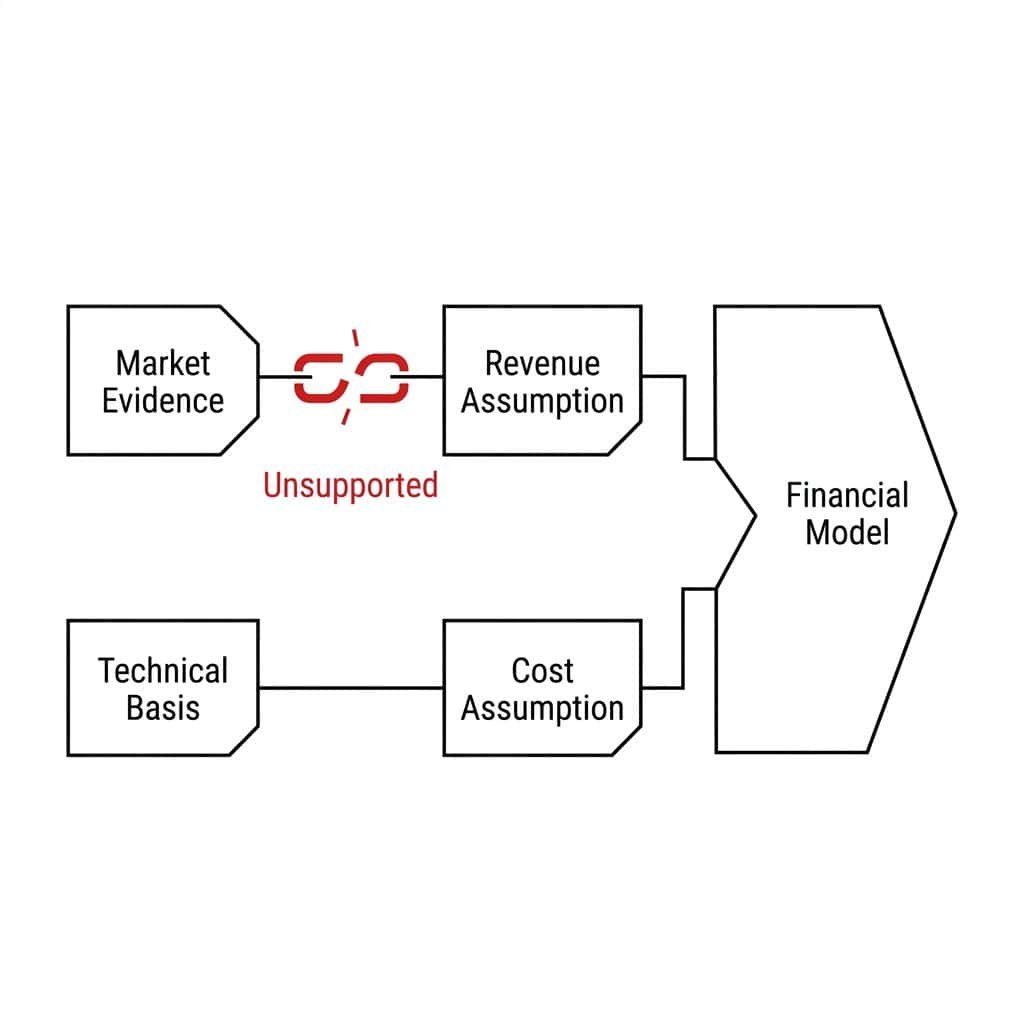
The financial case should be derived from the underlying project assumptions. A spreadsheet showing attractive returns does not establish feasibility if the assumptions behind those returns are unsupported.
7. Test important assumptions
A feasibility study should examine what happens when material assumptions change.
Depending on the project, this may include lower revenue, higher costs, reduced production, delays, weaker demand, or other adverse conditions.
The objective is not to predict the future precisely. It is to understand which assumptions the project’s viability depends on and how sensitive the outcome is to changes in those assumptions.
How lenders evaluate a feasibility study
A lender reviewing a feasibility study is concerned not only with whether the project appears profitable, but with whether the assumptions supporting that conclusion are credible.
The lender’s analysis may focus on:
Revenue credibility
Projected revenue should have a defensible basis. Market demand, pricing, production or utilization assumptions, customer relationships, and offtake arrangements can all affect the reliability of projected income.
Cost credibility
Construction and operating costs need to correspond to the actual scope and operating requirements of the project.
Cash-flow capacity
For a financed project, projected cash flow needs to be considered in relation to the project’s financial obligations and repayment requirements.
Unresolved dependencies
Permits, land rights, contracts, construction arrangements, technical assumptions, and other unresolved matters can materially affect the feasibility conclusion.
Internal consistency
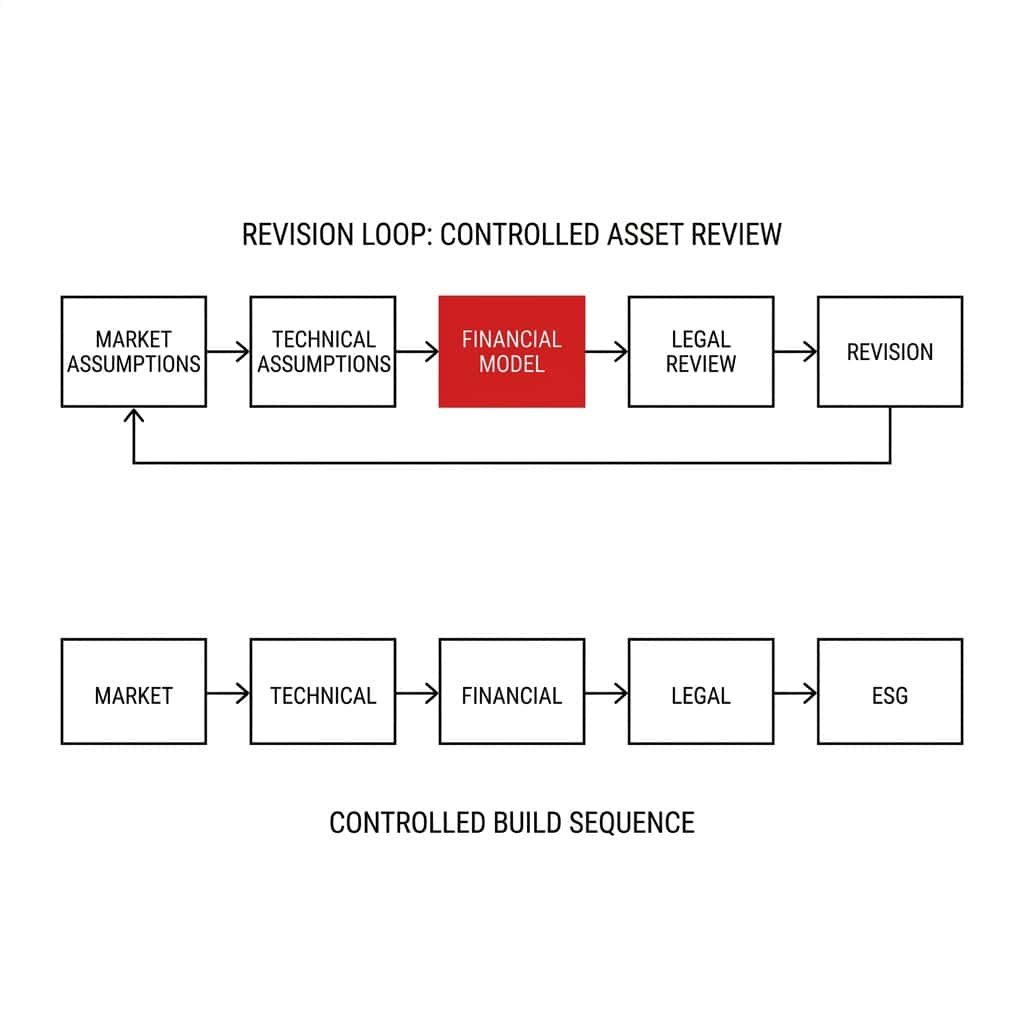
The technical, commercial, legal, operational, and financial parts of the study should describe the same project.
If the assumptions conflict between sections, confidence in the overall analysis is weakened.
Common feasibility study mistakes
Treating a feasibility study as a business plan
A business plan presents the opportunity and strategy. A feasibility study tests whether the underlying assumptions are actually achievable.
Starting with the desired financial result
Financial projections should follow from credible project assumptions rather than assumptions being selected to produce an attractive financial outcome.
Using unsupported market assumptions
Claims about demand, pricing, or market growth should have an appropriate evidentiary basis when they materially affect the project’s economics.
Ignoring dependencies
A project may appear viable only if several unresolved conditions are satisfied. Those dependencies need to be recognized rather than hidden inside assumptions.
Using inconsistent assumptions
Differences in capacity, timing, costs, production, pricing, or operating assumptions can undermine confidence in the entire study.
Showing only the base case
A base case alone does not demonstrate how dependent the project is on its most important assumptions.
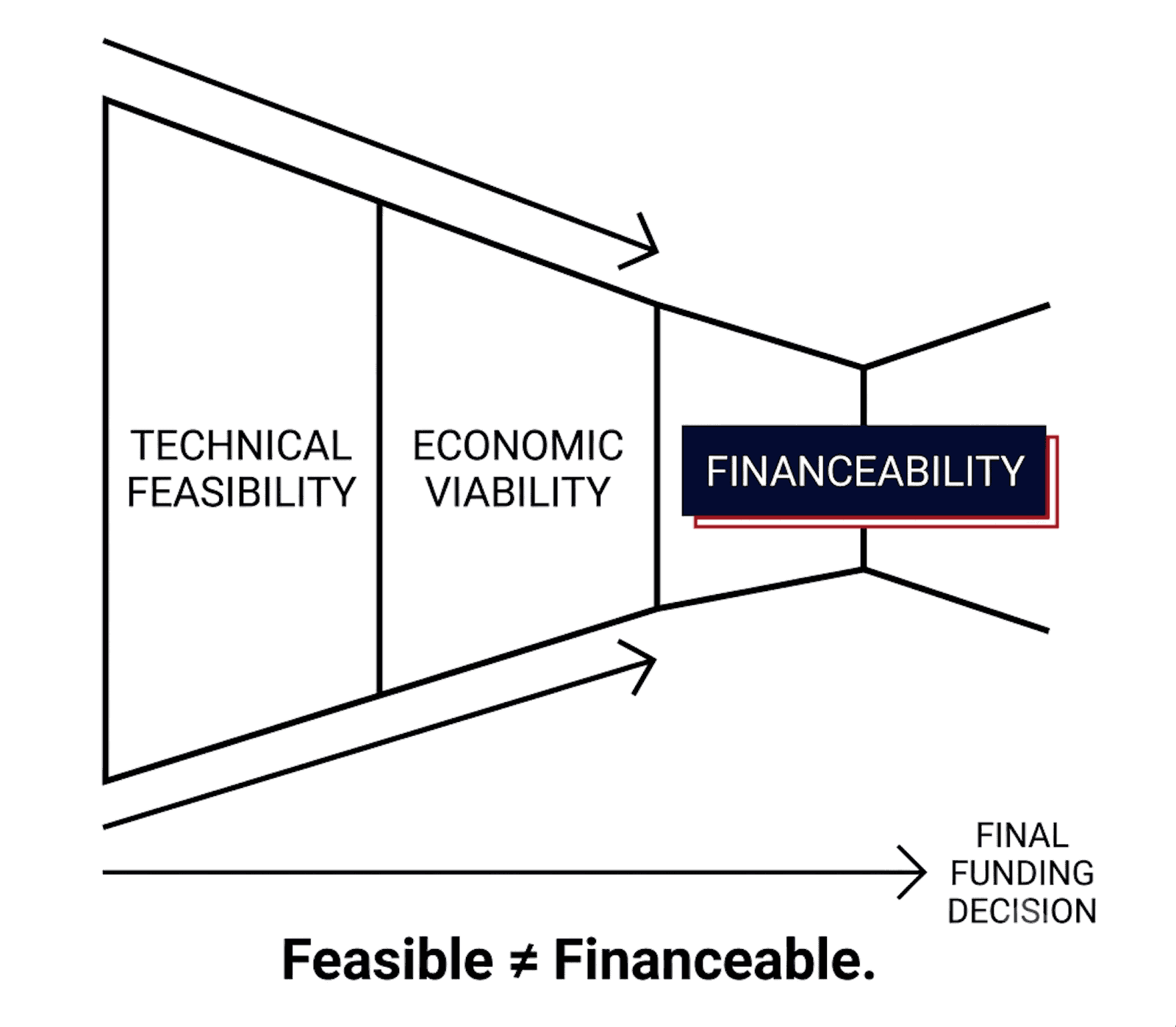
Confusing feasibility with financeability
A project can be feasible without being ready for financing.
Financing introduces additional considerations concerning repayment, security, contractual enforceability, sponsor contribution, risk allocation, and the proposed capital structure.
What happens when a feasibility study is weak?
A weak feasibility study creates uncertainty around the project’s assumptions.
That uncertainty can affect assessment of:
- projected cash flow;
- construction risk;
- market risk;
- operating risk;
- regulatory risk;
- contractual risk;
- cost overruns; and
- repayment capacity.
For a sponsor seeking financing, the practical result may be additional questions, requests for supporting evidence, revisions to assumptions, delays in review, or a decision not to proceed.
This does not necessarily mean that the underlying project is unsuccessful. It may mean that the available evidence is insufficient to establish whether the project works as presented.
Principles of a credible feasibility study
A credible feasibility study should follow several basic principles:
Evidence before conclusions
Material assumptions should be supported by appropriate evidence.
One consistent project
The technical, commercial, legal, operational, and financial analysis should describe the same underlying project.
Clear distinction between fact and assumption
Historical information, contractual commitments, third-party evidence, management assumptions, and projections should not be presented as having the same level of certainty.
Explicit treatment of uncertainty
Material uncertainties should be visible rather than buried inside optimistic assumptions.
Downside awareness
The analysis should show how material changes in important assumptions affect project viability.
Appropriate validation
Important technical, market, financial, legal, or regulatory assumptions should receive an appropriate level of specialist or independent validation.
Feasibility study vs. feasibility for financing
A general feasibility study asks whether the project is viable.
A feasibility study prepared in the context of external financing must also make clear why the assumptions supporting that conclusion can be relied upon.
This makes the quality and evidentiary basis of the underlying analysis particularly important. A project can be commercially viable while still requiring additional work before its assumptions are sufficiently supported for a financing review.
When should a feasibility study be prepared?
A feasibility study is most useful before major irreversible commitments are made.
It allows sponsors to test the project before committing substantial capital and can identify assumptions, dependencies, or risks that need to be addressed before development proceeds.
For projects seeking external financing, the study should also be sufficiently developed to support the wider financing review.
Final takeaway
A feasibility study determines whether a project can realistically work by testing its market, technical, commercial, legal, operational, and financial assumptions.
For financing purposes, the central issue is not simply whether the project appears profitable. The assumptions behind that conclusion need to be credible, supported by evidence, internally consistent, and sufficiently robust when important conditions change.
For readers who want a structured implementation framework for producing a financing-oriented feasibility study, the AltFin’s guide How to Produce a Feasibility Study That Lenders Will Not Ignore provides the next step.
