
Why Do Lenders Keep Asking for More Documents
When lenders keep requesting additional documents, it usually means they do not yet have enough verified information to complete their risk assessment. Lenders are not simply collecting paperwork — they are trying to determine whether a project is sufficiently understood, structured, and supported to move through internal review.
Repeated document requests often happen because information is incomplete, inconsistent, difficult to verify, or does not clearly address the questions lenders need answered before committing time and resources to a project.
For project sponsors, the issue is usually not the number of documents available. It is whether the documentation package is organized around the way lenders evaluate risk.
Why lenders request more documents
Institutional lending decisions require analysis across multiple areas, including project feasibility, technical risks, financial assumptions, legal structure, execution capability, repayment sources, and security arrangements.
When a lender reviews an initial submission, they are looking for evidence that allows them to answer fundamental questions:
- What exactly is being financed?
- Is the project technically and commercially viable?
- Are the financial assumptions credible?
- Are risks identified and properly addressed?
- Who is responsible for execution?
- What protections exist if the project underperforms?
If the submitted information does not provide sufficient clarity, the lender must request additional documentation before progressing.
A request for more documents is often a signal that the lender cannot yet form a complete view of the project.
How Lenders Evaluate Project Documentation
Lenders typically review projects through a risk-assessment process rather than a document-counting exercise.
They assess whether the information provided creates confidence in several key areas:
Project Definition and Scope
Lenders need a clear understanding of what is being developed, the current stage of the project, the required capital, and the intended execution pathway.
Unclear project scope, changing assumptions, or incomplete development information can create uncertainty early in the review process.
Technical and Commercial Validation
Lenders need evidence that technical studies, market assumptions, contracts, and development plans support the project case.
Documents are evaluated based on reliability, relevance, and whether they support the assumptions presented.
Financial Credibility
Financial information must allow lenders to understand how capital will be deployed, how the project generates returns, and how obligations can be repaid.
When financial assumptions are unsupported or disconnected from supporting documentation, lenders often request additional clarification.
Risk Allocation and Protections
Lenders examine how project risks are allocated between sponsors, contractors, operators, counterparties, and other stakeholders.
Documentation helps determine whether key risks are identified and whether appropriate contractual or structural protections exist.
Common Reasons Lenders Keep Asking for More Documents
Documents Are Provided Reactively Instead of Systematically
Many project sponsors provide information only when a lender requests it. This can create a cycle where each new document reveals another unanswered question.
A lender-review-ready submission anticipates the areas that require evidence and presents information in a way that supports efficient review.
Information Is Difficult To Locate or Verify
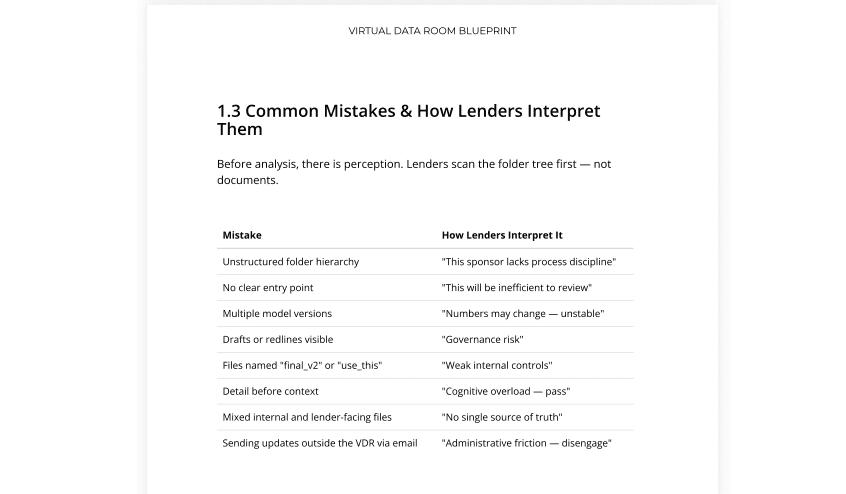
Even when the necessary documents exist, poor organization can slow review.
Lenders and their advisors need to quickly identify relevant information, confirm versions, and understand how documents relate to the overall project.
Different Documents Contain Conflicting Information
Inconsistencies between feasibility studies, financial models, investor materials, contracts, and technical reports can create additional questions.
Before relying on submitted information, lenders must understand which assumptions are current and which sources should be considered authoritative.
Key Risk Areas Are Not Adequately Documented
A project may appear well-developed while still lacking documentation around important lender concerns, such as execution risks, contractual arrangements, approvals, or financial support.
When these areas are unclear, additional requests are a natural part of the review process.
The Consequences of an Incomplete Documentation Approach
Repeated document requests can create several challenges:
- Longer review timelines
- Increased lender uncertainty
- Additional internal scrutiny
- Higher perceived preparation risk
- Reduced confidence in the sponsor’s readiness
A lender may interpret unclear documentation not only as a documentation issue, but also as a potential indicator of broader project preparation weaknesses.
For large-scale projects, the quality of the submission package influences how efficiently reviewers can understand and evaluate the opportunity.
How Project Sponsors Can Reduce Repeated Document Requests
Build Documentation Around Lender Questions
A strong submission starts by understanding what lenders need to verify, not simply by collecting every available project document.
The objective is to create a coherent information package that allows reviewers to evaluate the project without repeatedly searching for missing context.
Maintain Consistency Across All Project Materials
All materials presented to lenders should reflect aligned assumptions, current information, and clearly defined sources.
Consistency improves credibility and reduces unnecessary clarification cycles.
Prepare Before Approaching Lenders
Many documentation problems appear because preparation begins after lender engagement has already started.
A more effective approach is to review the project documentation package before submission and identify areas where reviewers are likely to require clarification.
Treat the Data Room as Part of the Financing process
A virtual data room is not simply a storage location for files. It is the environment through which lenders, advisors, and reviewers understand the project.
A structured data room helps create a clearer review experience and reduces friction during due diligence.
The Difference Between Having Documents and Being Review-Ready
A project can have hundreds or thousands of documents and still be difficult for a lender to evaluate.
Capital readiness depends on whether the information is complete, organized, consistent, and presented in a way that supports professional review.
The goal is not to provide more documents. The goal is to provide the right information in a form that allows lenders to assess the project efficiently.
How to Prepare a Lender-Ready Virtual Data Room
For sponsors who want a structured approach to organizing project documentation before lender review, AltFin provides:
How to Build a Virtual Data Room That Gets Your Project Reviewed (AltFin VDR Blueprint)
This practical resource is designed for project sponsors who need guidance on preparing a professional virtual data room structure aligned with lender review expectations.
A well-prepared documentation package does not guarantee financing, but it can help lenders understand the project more efficiently and identify the information required for meaningful evaluation.
